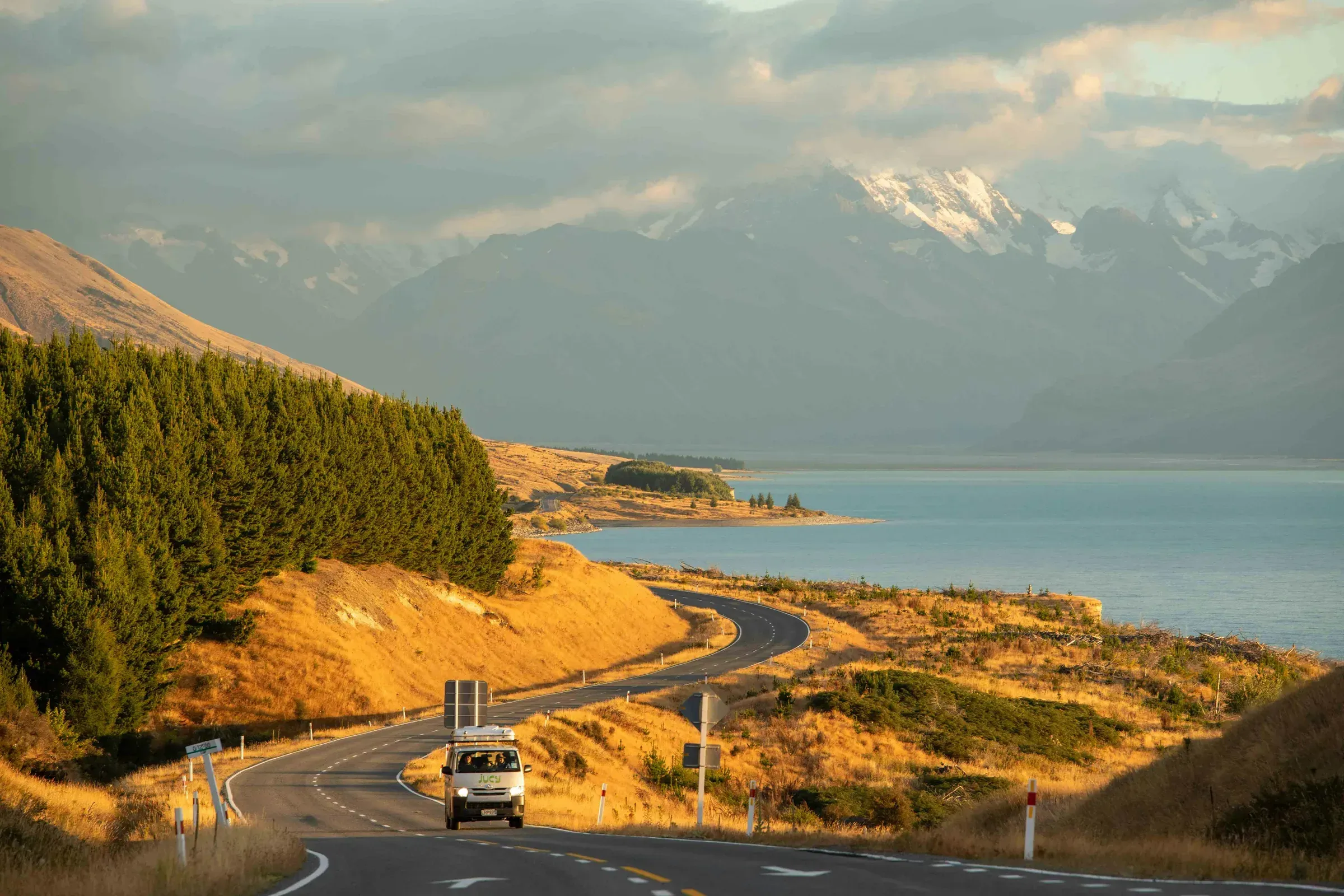
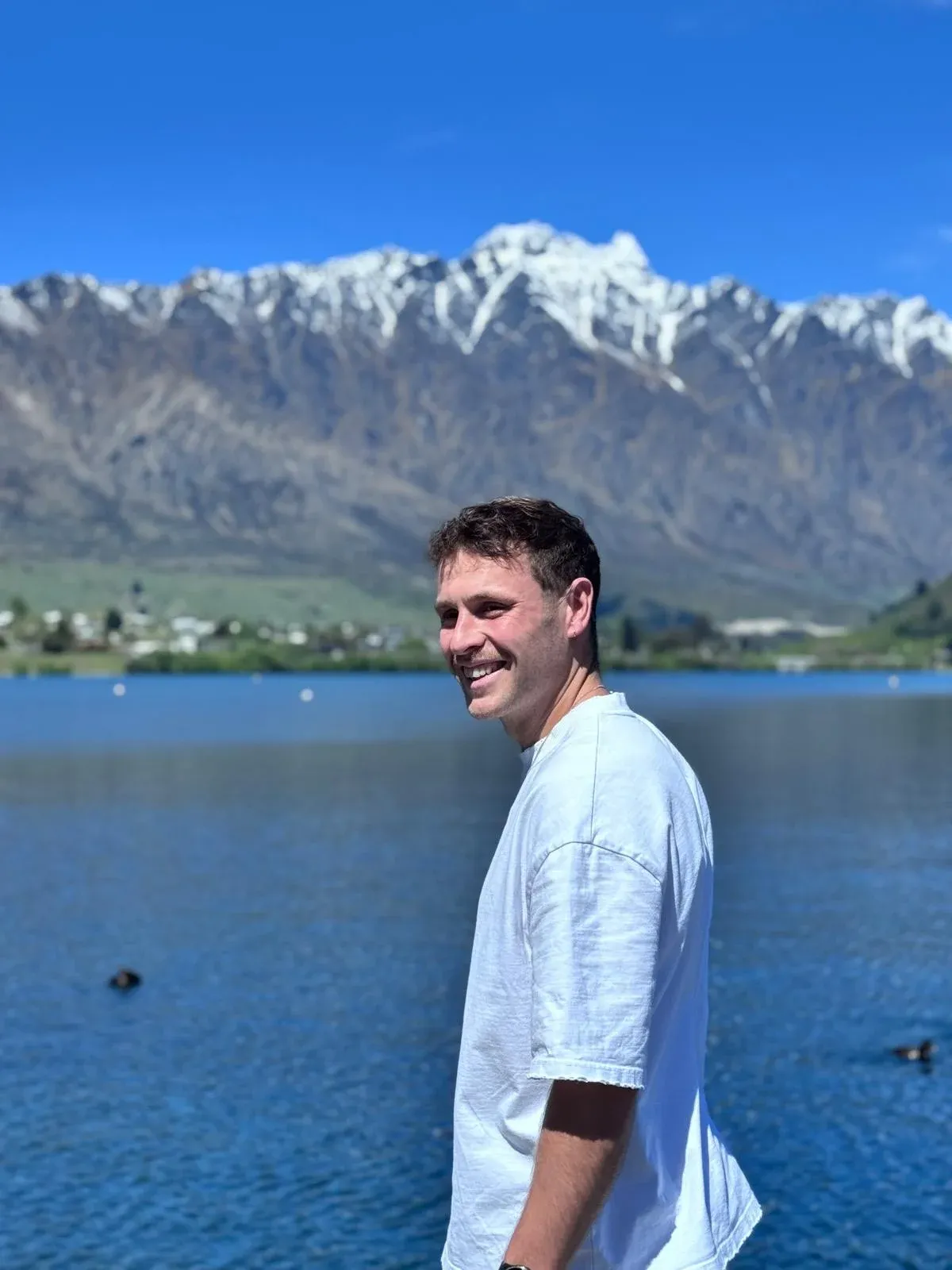
In November 2025, I took my niece Iris and her partner Thijs on a road trip through New Zealand. What a trip it was! Glaciers and golden beaches, film sets and volcanoes: this country really does have it all.
Over four weeks we traveled by campervan from the South Island up to the North Island. For most people, landing in Christchurch (or Auckland, if you do the route the other way around) is when you first need to recover from the long trip over. My advice? Don't plan anything for day one and, depending on when you land, give yourself time to properly catch up on sleep.
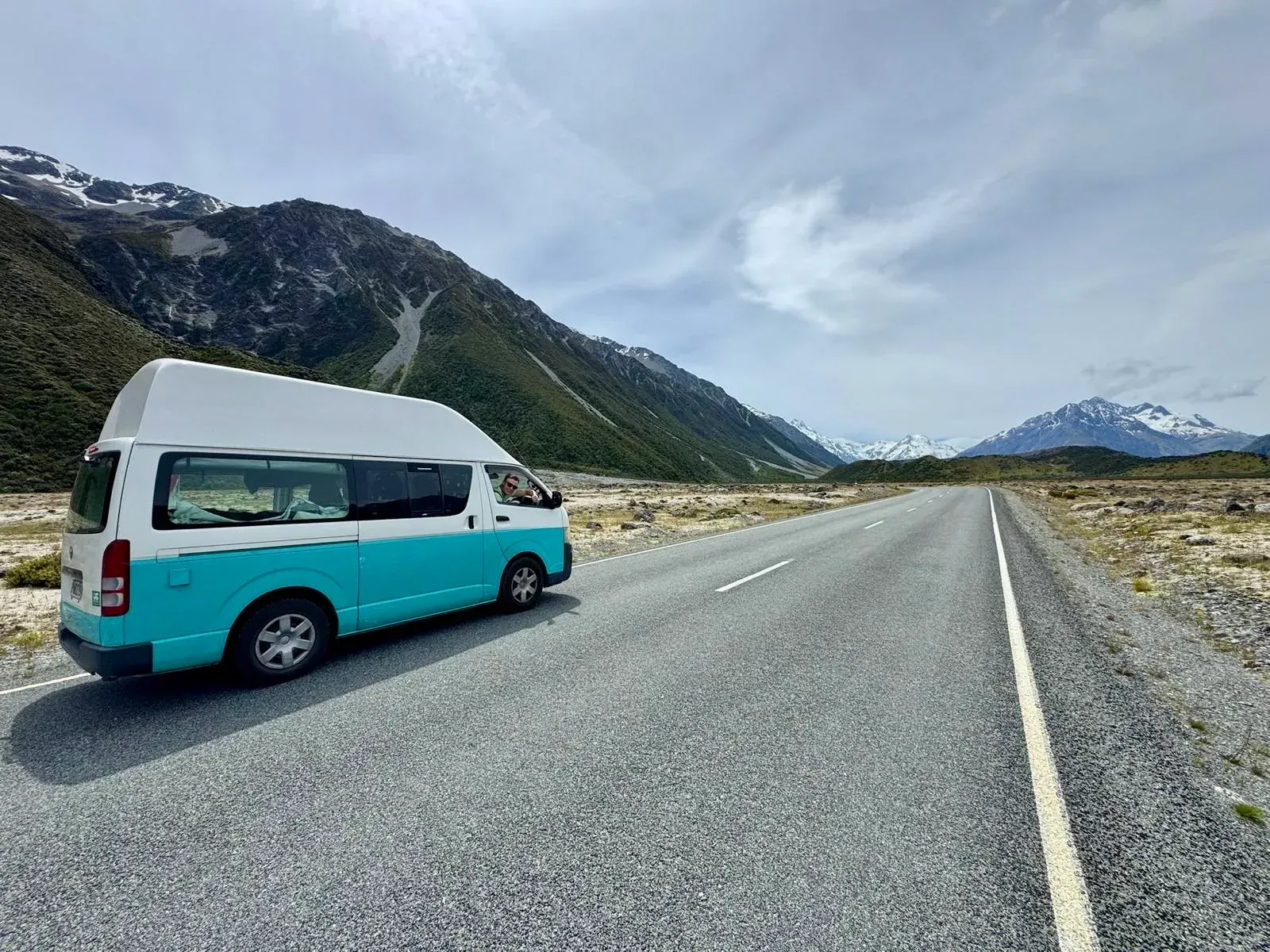
For this trip I'd booked two campervans from Barefoot Campers. They're great for a medium-length road trip and a perfect fit for solo travelers or couples. At Good Day Travels I'm happy to help you book the right campervan and plan your dream trip.
Below is my full trip report, with tips on campgrounds, walks and things to see.
New Zealand is at its best when you're free to choose your own route.
And what better way to do that than a road trip in your own campervan?
The route at a glance
17 stops, 27 days
- Day 1-2Christchurch → Rakaia Gorge
- Day 3-4Rakaia Gorge → Lake Tekapo → Aoraki / Mt Cook National Park
- Day 4-5Aoraki / Mount Cook → Twizel
- Day 5-9Twizel → Queenstown
- Day 9-10Queenstown → Franz Josef
- Day 10-11Franz Josef → Hokitika Gorge
- Day 11-12Hokitika Gorge → Punakaiki
- Day 12-14Punakaiki → Abel Tasman National Park
- Day 14-15Abel Tasman National Park → Nelson
- Day 15-16Nelson → Picton, via the Queen Charlotte Drive
- Day 16-17Picton → Wellington
- Day 17-18Wellington → Tongariro National Park
- Day 18-19Tongariro National Park → Waitomo Glowworm Caves
- Day 19-21Waitomo → Lake Taupo
- Day 21-23Lake Taupo → Rotorua
- Day 23-24Rotorua → Hobbiton Movie Set
- Day 24-27Hobbiton → Waiheke Island
Christchurch – Rakaia Gorge
As soon as we landed at Christchurch Airport, we went straight to pick up the campervans, so our transportation and our beds were taken care of from the start. For this campervan trip through New Zealand I'd booked two campervans from Barefoot Campers. They're ideal for a medium-length road trip and well suited to solo travelers or couples who want to see New Zealand by campervan.
Christchurch: easing in after the long flight
We kept the afternoon easy on purpose. Christchurch is a nice city to start a campervan trip: compact, green and relaxed. We walked around the center and checked out New Regent Street, one of the city's most charming streets, with colorful storefronts, boutiques and nice cafés.
A fun way to see Christchurch is the hop-on hop-off tram, which loops through downtown in vintage streetcars. We thought it was one of the most enjoyable, low-effort ways to see the city, especially when you've just arrived.
In the evening we finished the day with a drink at The Church Pub, a pub with a great atmosphere that, as the name suggests, is in a former church. A special place, and a great way to kick off our road trip through the South Island.
Breakfast in Christchurch and hitting the road
The next morning we slept in, which I always recommend after a long flight. Then we got the day going with a big brunch at Bobby's Brunch. The food isn't just delicious, it's also beautifully plated. Definitely worth a stop if you're in Christchurch.
After brunch we wandered around downtown for a bit, browsed a few shops and picked up the last few things before we really hit the road. In the early afternoon we climbed into our campervans and started the first leg of our New Zealand campervan trip, heading for Lake Tekapo.
The route to Rakaia Gorge
There are two ways to drive from Christchurch to Lake Tekapo. We chose State Highway 77 via Inland Scenic Route 72 on purpose, instead of Highway 1. It's a lot quieter and greener, and the scenery changes much more along the way.
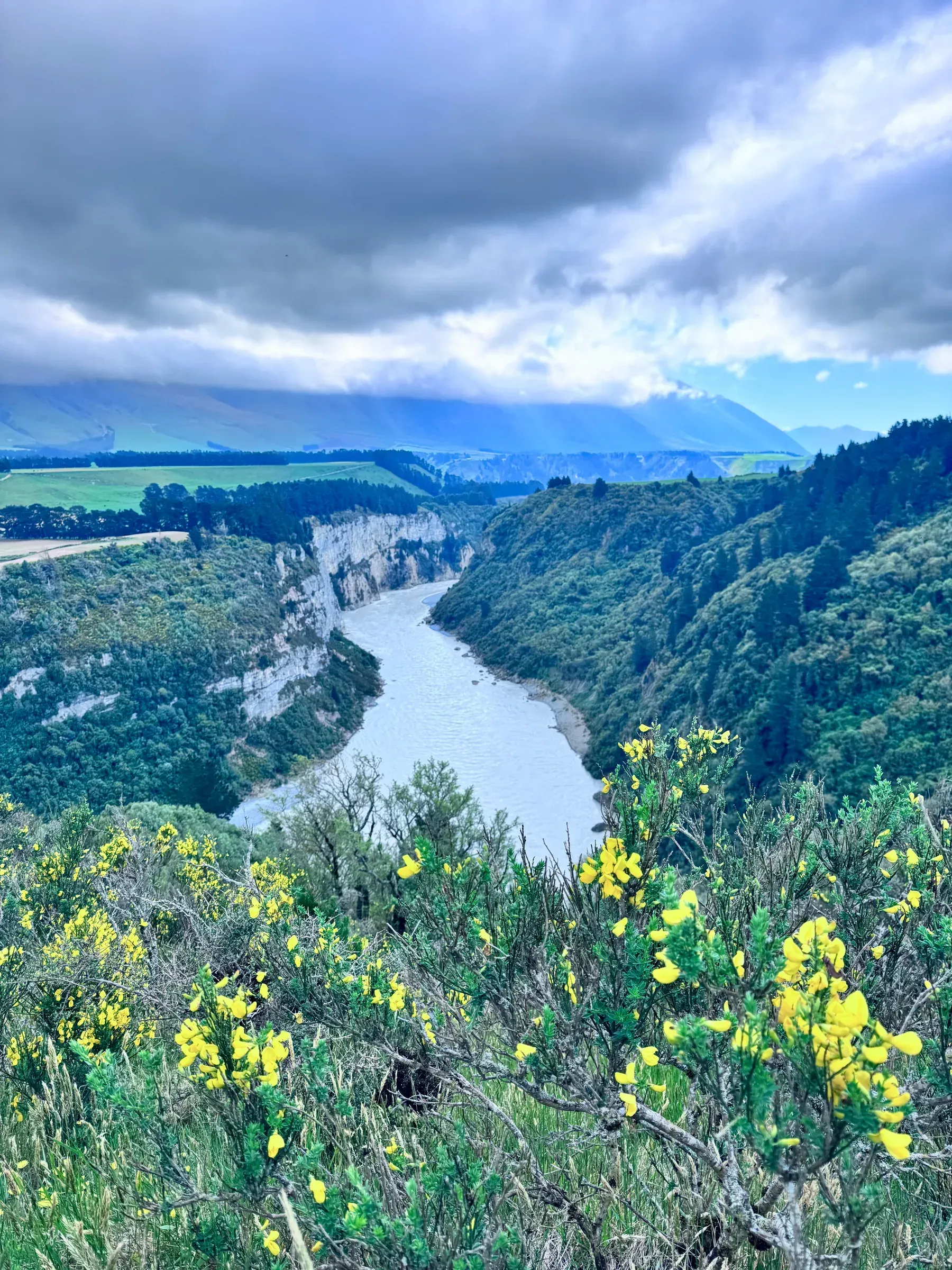
After about an hour on the road, you reach Rakaia Gorge, an impressive canyon with bright blue river water. There's a beautiful walk here of about 10.5 kilometers round trip that follows the top of the gorge, with views over the Rakaia River the whole way.
Spending the night at Rakaia Gorge
Rakaia Gorge also has a nice, simple campground where you can stay for around NZD $15 per person. We decided to stay, do the walk and spend our first night in the campervans. Falling asleep with a view of the river and nothing but nature around us was the perfect start to the road trip.
Another option: push on to Fairlie
If you leave Christchurch earlier in the morning, you can also keep driving to Fairlie after the Rakaia Gorge hike (± 3 hours of driving in total). A nice place to spend the night is Musterer's Accommodation Fairlie, a quiet campground with alpacas. For dinner and drinks, I recommend the Silverstream Hotel, just a five-minute drive away.
Rakaia Gorge – Lake Tekapo – Aoraki / Mt Cook National Park
The next morning we left Rakaia Gorge early. We were headed for Aoraki / Mount Cook National Park, but we'd left plenty of time for a long stop at Lake Tekapo. One of the best things about traveling New Zealand by campervan is that you can stop wherever and whenever you like.
From Rakaia Gorge it's a little over two hours to Lake Tekapo. On the way we stopped at the Fairlie Bakehouse in Fairlie for a quick breakfast and a coffee. Their pies are known as some of the best in New Zealand, and we can confirm that.
A tip on the way:
About 20 minutes before Lake Tekapo you drive through Burkes Pass. This is where you'll find Three Creeks - Vintage Garage Decor, a fun stop full of vintage pieces, classic cars and old signs and decor that make it feel like a village from another era.
Hiking at Lake Tekapo
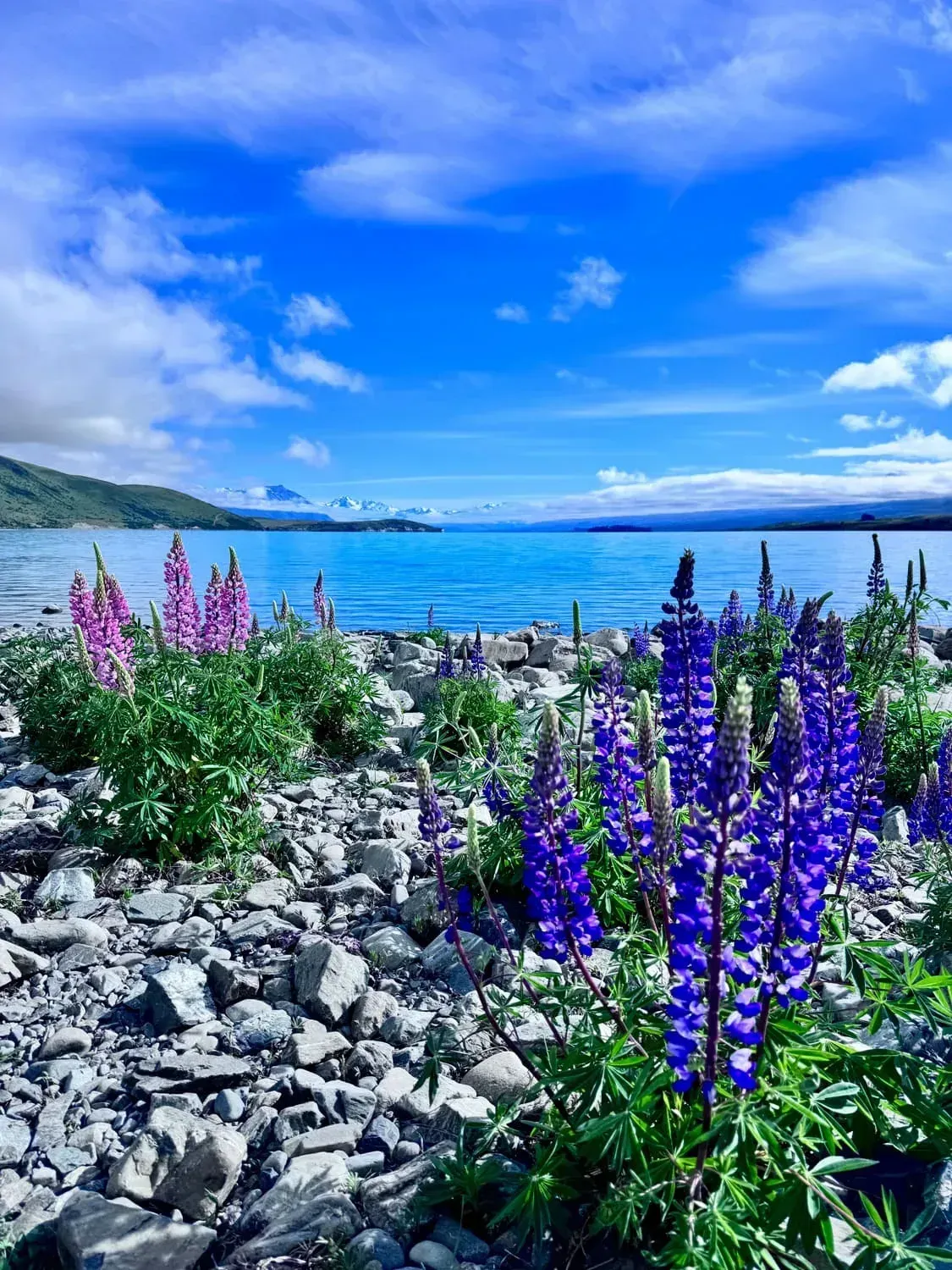
We got to Lake Tekapo around 10 a.m. and started with the Lake Tekapo Peninsula Walk. This short loop of about 5 km has gorgeous views over the bright blue lake, with the Southern Alps behind it. It's the perfect walk to stretch your legs after a drive. From mid-November to around mid-January, the famous lupins are in bloom here. The pink and purple flowers light up the whole area, and the views are incredible!
Want a longer walk?
Then the Mt John Summit Circuit Track is a great choice. This 8.5 km loop takes you along Lake Tekapo and up Mount John, where you get a panoramic view over the lake and the mountains around it.
After the walk we made lunch at the campervan, one of the things that makes campervan travel so great, and then drove on toward Mount Cook National Park.
On to Mount Cook National Park
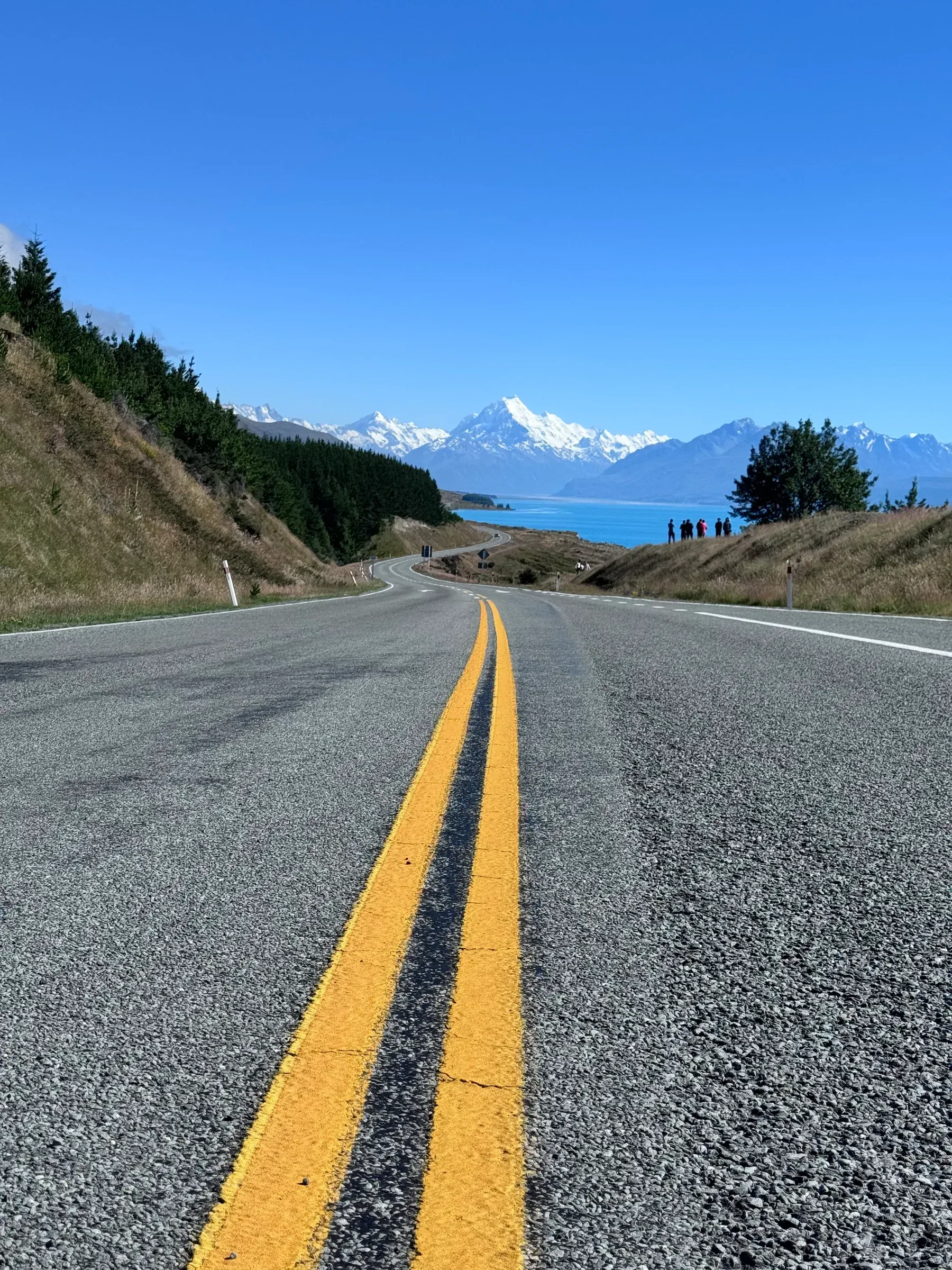
From Lake Tekapo it's about another 1.5 hours to Mount Cook National Park. The drive alone is impressive, with the mountains getting bigger and bigger and glaciers in the distance.
We'd booked a night at White Horse Hill Campground. It sits right in the middle of the national park and is the starting point for several well-known walks, including the iconic Hooker Valley Track.
Red Tarns Track
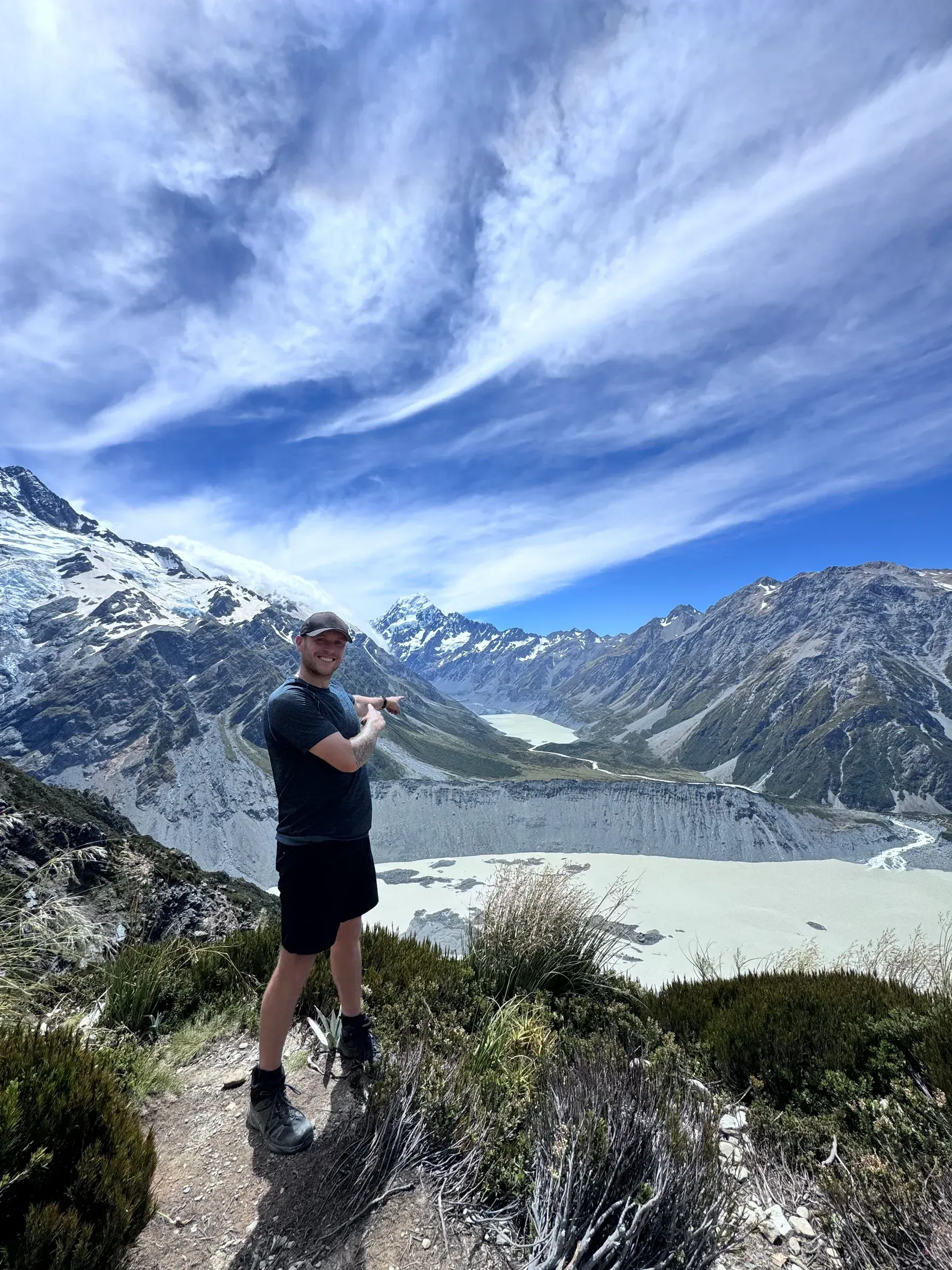
In the late afternoon we decided to do the Red Tarns Track first. It's fairly short (± 3.5 km round trip), but it's steep. It's a bit of a grind, but the view from the top is unreal. You look out over Hooker Valley and Mount Cook, with a remote mountain tarn in the foreground. A must if you're short on time but still want to do something spectacular.
Hooker Valley & Tasman Valley
The next day we started with the famous Hooker Valley Track. This 10 km round-trip walk is easy, and it takes you through a rugged, rocky landscape to Hooker Lake, where chunks of glacier ice often float in the water. It's busy, but it's still one of the most beautiful walks in New Zealand.
After Hooker Valley we drove over to the Tasman Valley and did the short climb to the lookout over Tasman Lake and the Tasman Glacier. A completely different angle, but just as impressive.
Hikes in Mount Cook National Park at a glance
Here's an overview of the walks you can do in Mount Cook National Park. I've done every one of them, because I came here often as a tour guide while I was working in New Zealand.
Walking track | Distance | Difficulty
Hooker Valley Track | ± 10 km round trip | Easy
Kea Point Track | ± 2.8 km round trip | Easy
Sealy Tarns Track | ± 5.8 km round trip | Challenging (2,200 steps)
Mueller Hut Route | ± 10.4 km round trip | Challenging
Tasman Glacier View | ± 2.6 km round trip | Easy
More tips for Mount Cook National Park:
- Mount Cook National Park is a popular day trip for tourists. Try to do your walks early or late in the day.
- Always bring warm, waterproof clothes. Even in summer it can be cold here, and the weather can change fast.
- Try to plan your visit for a sunny day. Mount Cook is often hidden in the clouds.
- Bring enough food and water. There are almost no facilities in the national park.
Aoraki / Mount Cook – Twizel
After our night in Aoraki / Mount Cook National Park and several hikes, we decided to take it easy that day. We already had quite a few kilometers in our legs and didn't feel like another long day behind the wheel. So we headed for Twizel, a short drive of about 45 minutes.
Just before you reach Twizel you'll find Lake Wardell Campsite. It's a basic, free campground and a good place to stay for one night. It's quiet and spacious, with a drop toilet. Don't expect luxury, but for a short stop it's a great spot, especially if you're traveling in a self-contained campervan.
Prefer a bit more comfort?
Then Twizel Holiday Park is a good option. It's right in Twizel and has full facilities, including showers, restrooms and a shared kitchen. Ideal if you want to recharge during your South Island road trip.
Twizel – Queenstown
On day five of our New Zealand road trip, it was time to show my guests Queenstown, where I'd been living for eight months by then. From Twizel it's only about twenty minutes to Omarama. Right where the town begins is The Wrinkly Ram café, a perfect stop for a good cup of coffee and a hearty breakfast.
By late morning we pulled into Queenstown. Iris had booked four nights at Hampshire Holiday Parks - Queenstown Lakeview. It's not the coziest campground, but it's right in the middle of town, so everything is within walking distance.
Tip: Book campgrounds in and around Queenstown as early as you can; they're often full months ahead.
Alternative: Queenstown Holiday Park Creeksyde is greener and has more character, and it's also within walking distance of downtown.
Day 5
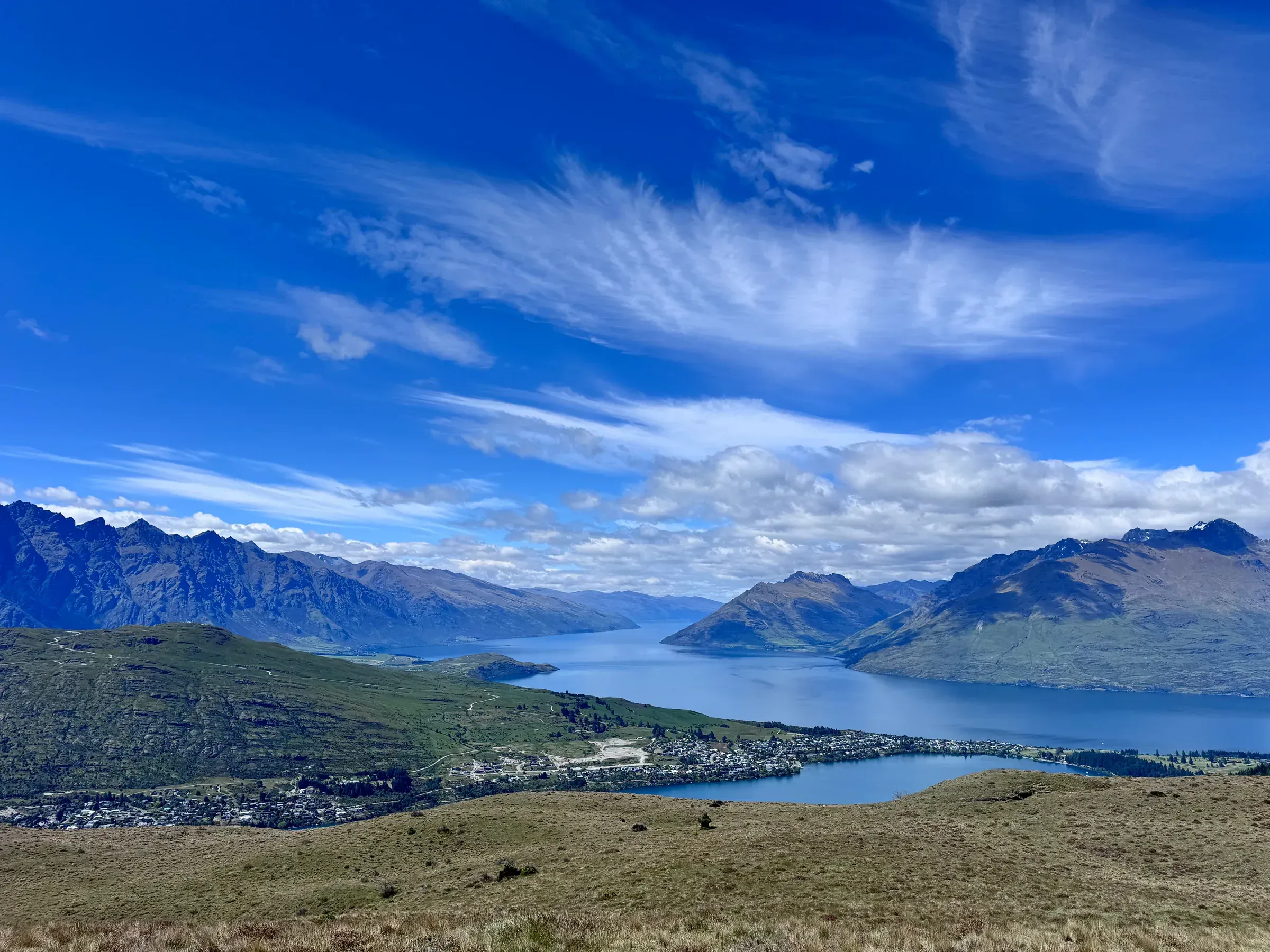
Once we'd arrived, Iris and Thijs settled in at the campground while I took care of a few things at home. Later that afternoon we walked into town, browsed the shops and had drinks at a few different pubs.
Day 6
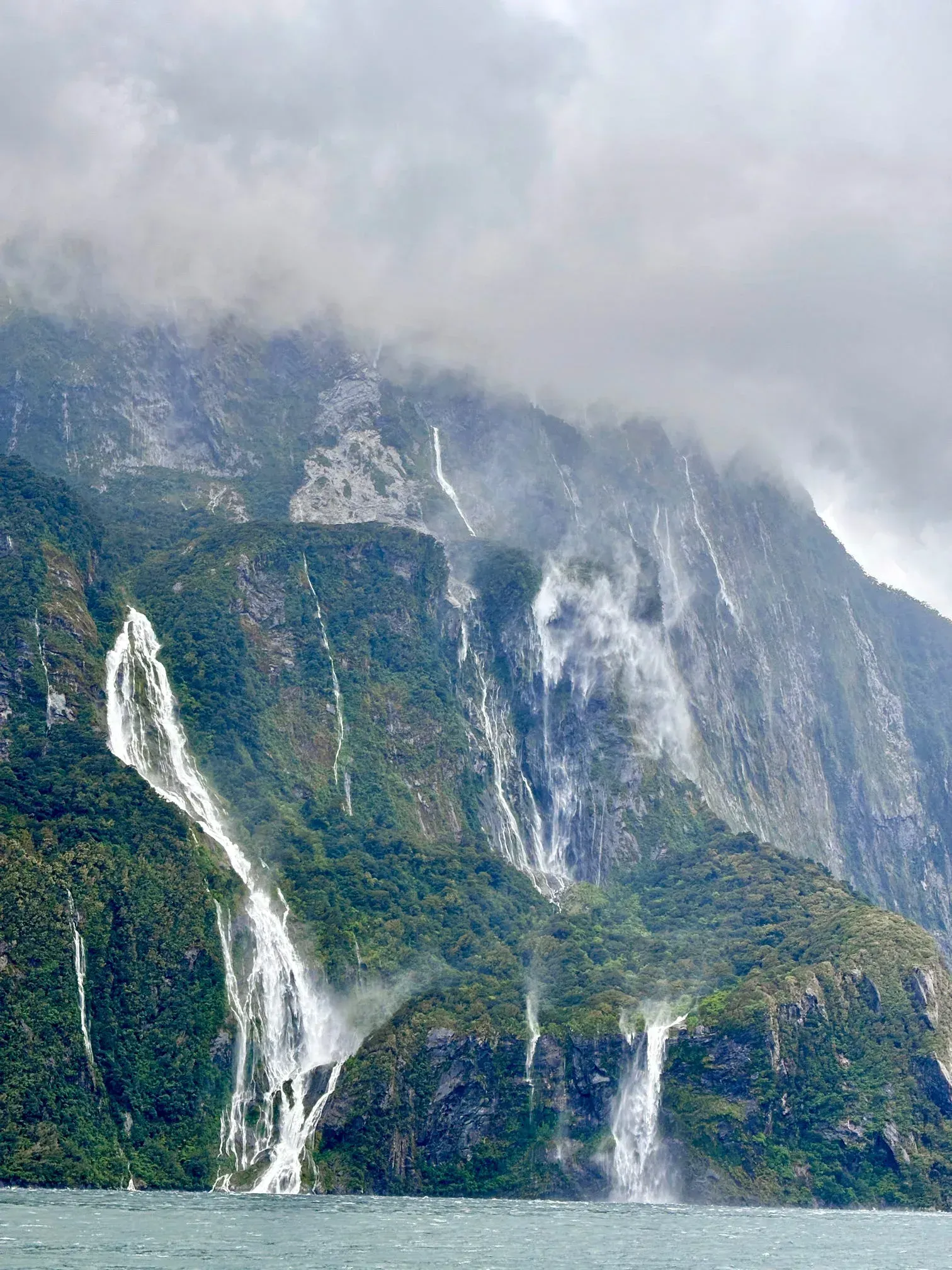
On our second day, Milford Sound was on the schedule. If you ask me, it's a must when you visit Queenstown. At the time I was working as a guide for Cheeky Kiwi Travel, which runs a day trip from Queenstown to Milford Sound and back. Got enough time? Drive it yourself and spend a night in Fiordland National Park! On the day we went, I was the guide myself, so taking my family along made it extra special. Milford Sound is impressive in any weather: sunshine means crisp blue views, and rain brings out hundreds of waterfalls down the steep cliffs. On the day trip we went out on the fjord in a smaller boat (book it through Cruise Milford or Mitre Peak), which gets you closer to the waterfalls and rock walls. Highly recommended!
Day 7
In the morning we drove to Arrowtown, about twenty minutes from Queenstown. It's known as 'New Zealand's prettiest town' and was founded during the 1862 gold rush. We visited the Gold Museum and walked through the historic Chinese Settlement, a remarkable piece of protected heritage left by the Chinese gold miners. Arrowtown has plenty of nice cafés and restaurants; we had lunch at Ayrburn, a beautiful vineyard with several places to eat.
In the afternoon we went to Kiwi Park Queenstown, right downtown. You can see almost all of New Zealand's native bird species here, including the kiwi, which you'll rarely spot in the wild. At the entrance you walk through the Honeycomb Centre, where you can buy Manuka honey, among other things.
Day 8
On our last full day we did a morning Lord of the Rings tour to Glenorchy with Nomad Safaris. We rode in 4×4s past filming locations like Isengard, Lothlórien and Fangorn Forest. The area past Glenorchy, fittingly called Paradise, is spectacular! I work here as a tour guide too, so it was great to show my family what I do for a living.
When we got back, we had lunch at Bespoke Kitchen. In the late afternoon we boarded the historic TSS Earnslaw for a cruise across Lake Wakatipu, followed by a big BBQ dinner across the lake at Walter Peak, a working sheep farm. After dinner we watched a farm show with sheep shearing and working dogs, then took the boat back to Queenstown around 8:15 p.m., with live music on board and a peek into the warm engine room.
Queenstown – Franz Josef
- Cardrona Hotel
- Wanaka
- Blue Pools
- Ship Creek
- Fox Glacier
After our time in Queenstown, it was time to move on. We were driving to Franz Josef in one day, so we left around 8 in the morning. We had quite a few stops planned along the way, so we needed every bit of that time. Here's each stop:
Cardrona Hotel
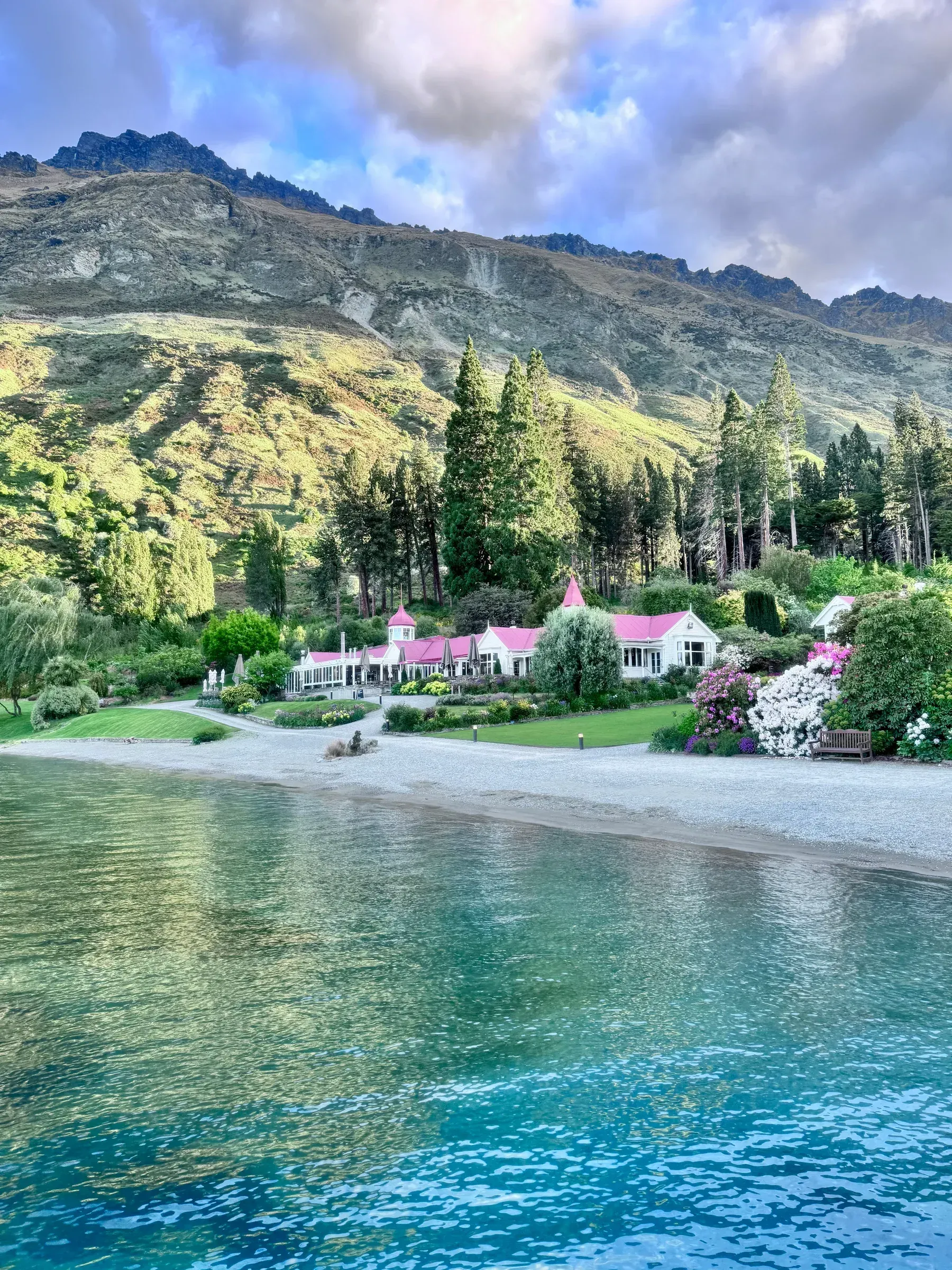
The Cardrona Hotel is well worth a visit. You'll find it about 45 minutes' drive from Queenstown, and it was built in 1863, which makes it one of the oldest hotels in New Zealand! In spring and summer it's covered in flowers and looks like something out of a movie. We had a coffee here and took some photos.
Wanaka
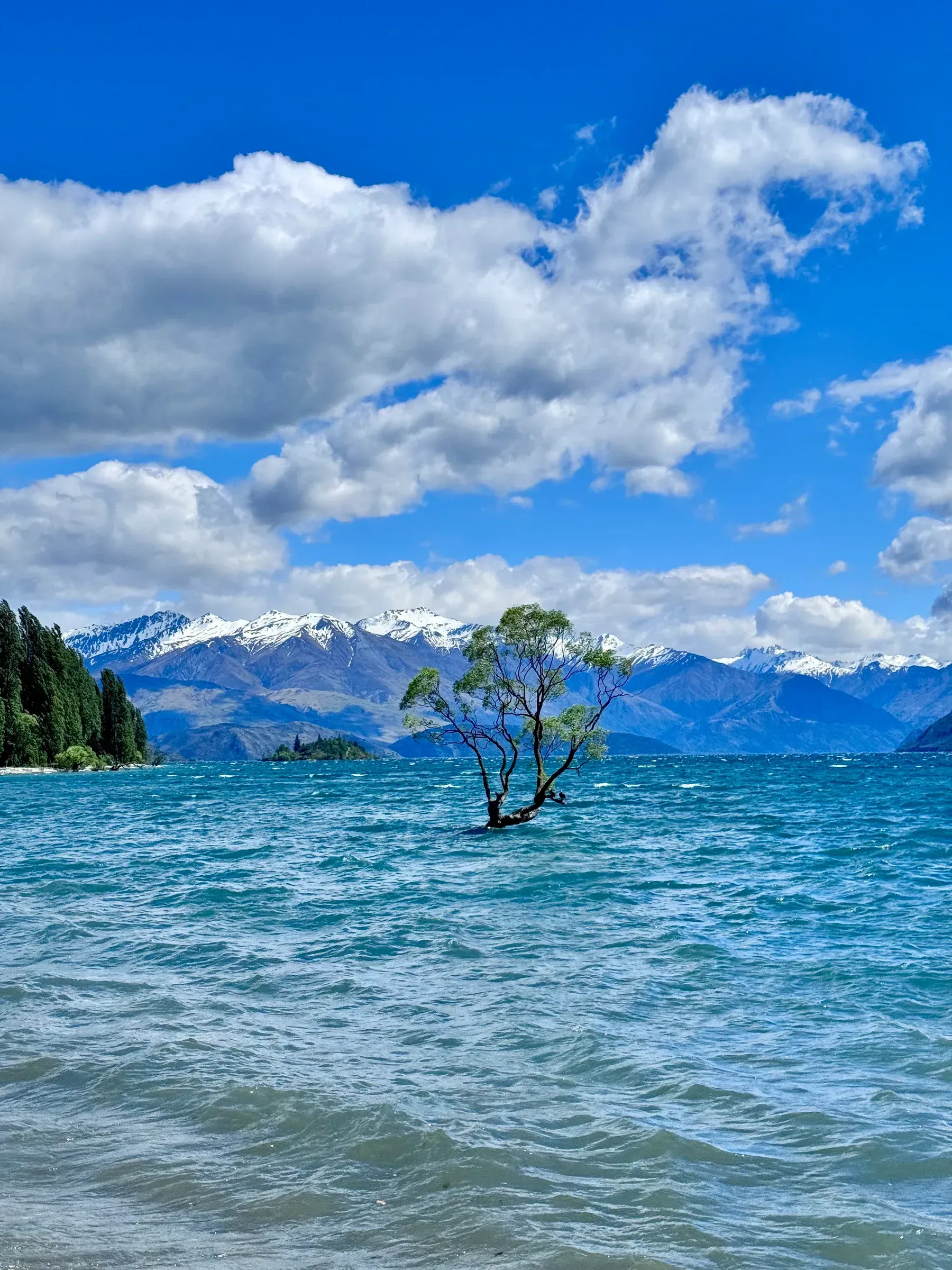
From the Cardrona Hotel it's about another 20 minutes to the lovely little town of Wanaka. It sits right on Lake Wanaka, with great views of the mountain ranges on the far side. In the lake itself is the famous 'Wanaka Tree', a willow standing out in the water that draws huge numbers of tourists. We walked down to it, and it's a fun sight. Go as early as you can, especially on a nice day. From late morning on, there are literally hundreds of people here taking photos.
Just outside Wanaka is Pembroke Patisserie. We grabbed a quick breakfast to go here before heading on.
Blue Pools
The drive from Wanaka to the Blue Pools is pure heaven. From Wanaka you first head to Lake Hawea and follow its shore for about 20 minutes. Think bright blue water with huge mountain ranges behind it! Past Lake Hawea you turn off and drive along the northern end of Lake Wanaka. That stretch is stunning too, and literally every bend shows you something new.
After an hour's drive you reach the Blue Pools parking lot. The pools are known for their crystal-clear, intensely blue water, fed by meltwater from the Makarora River. You get there on the short, easy Blue Pools Track, a walk through native beech forest. On this 15-20 minute walk you cross several swing bridges with great views of the pools and the Southern Alps around them.
Fantail Falls & Thunder Creek Falls
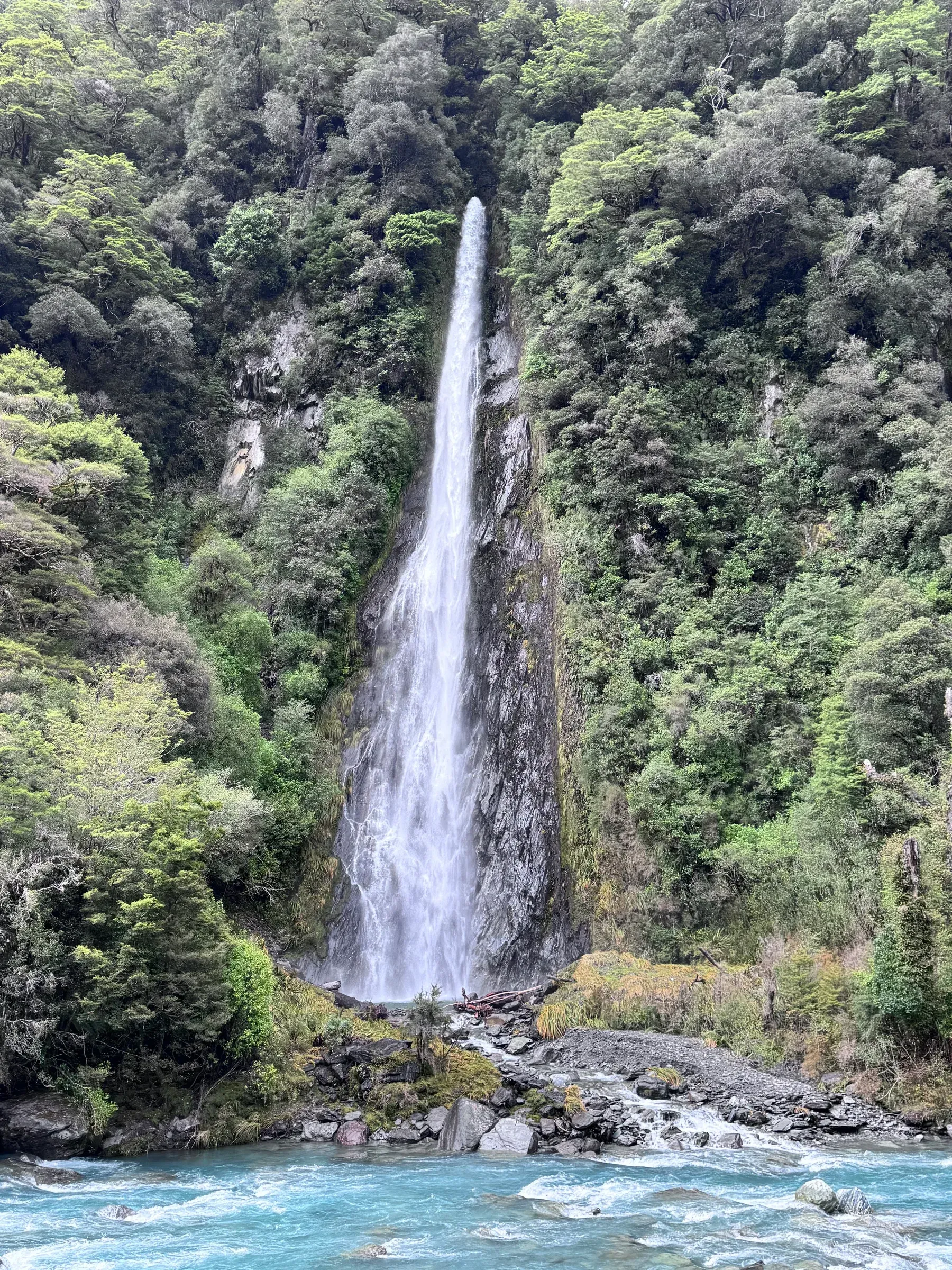
Heading from the Blue Pools to the West Coast, you soon pass two waterfalls, Fantail Falls and Thunder Creek Falls. Both are worth a quick stop. They're just a 1-minute walk from the parking lot, so you can see them in 5 minutes. They're at their best in spring (September through November), when there's a lot of water coming down.
Ship Creek
From Thunder Creek Falls you reach the coast within 45 minutes, and for most of the rest of the drive the ocean is on your left. Soon after, you come to a place called Ship Creek. On a nice day it's worth stopping for a short walk with ocean views and a few lookouts for great photos. On a gray or rainy day, though, there isn't much to see, and you're better off saving the time and driving on.
Fox Glacier
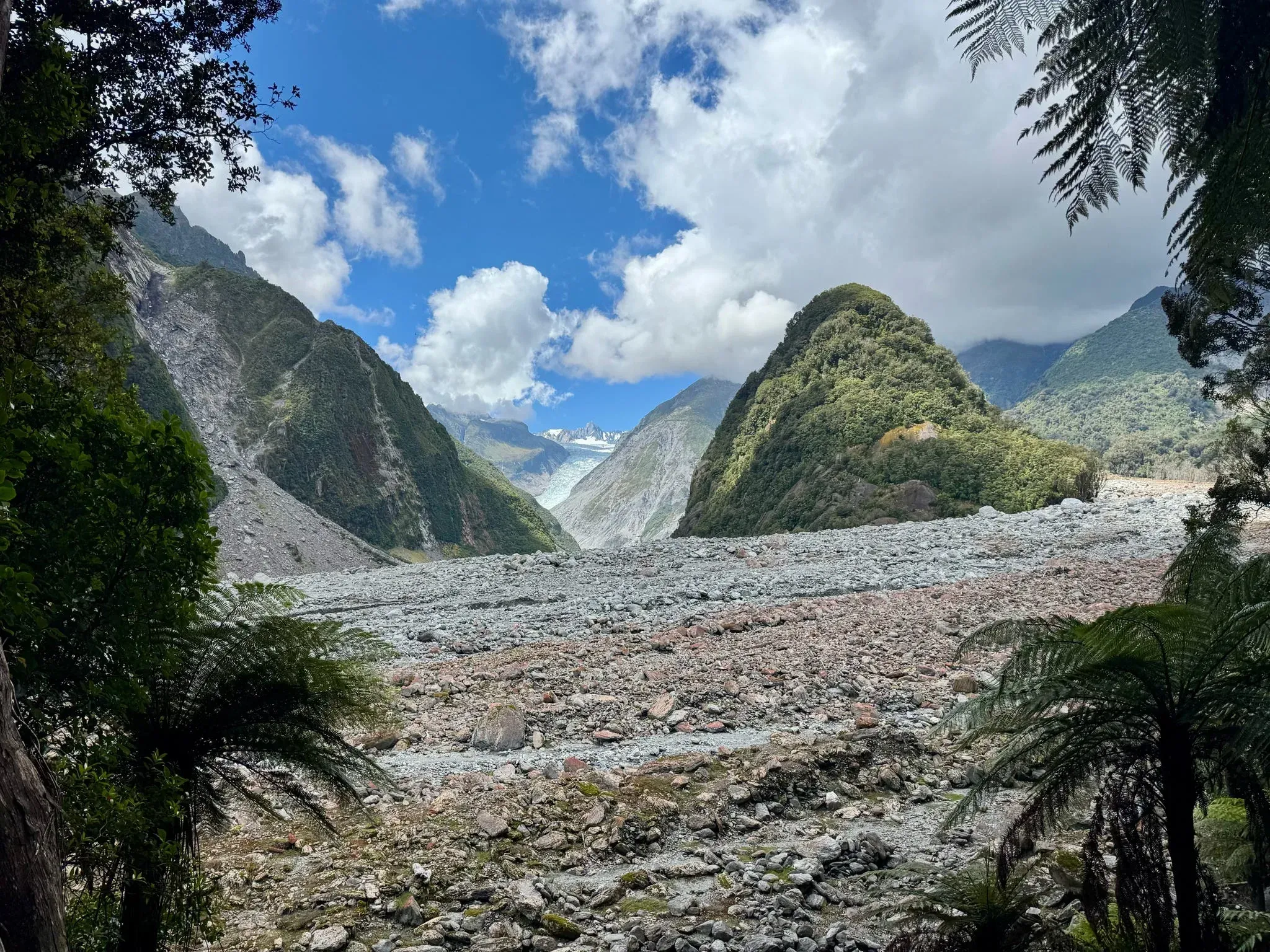
Half an hour before Franz Josef you pass through Fox Glacier. Just before the village there's a turnoff to the parking lot for the Fox Glacier South Side walk. From there, the first lookout is about a 30-minute walk. The trail climbs gradually but is well maintained, so it's easy going. If you walk another 15 minutes past the first lookout, the view gets even better, and it's definitely worth it if the clouds aren't too thick.
Franz Josef
We finally rolled into Franz Josef around 5 in the afternoon. We'd booked a night at Orange Sheep Campervan Park, which has powered and unpowered sites. An unpowered site costs just NZD $20 per person (NZD $25pp in high season), which is a very fair price for the location and facilities. Staying here feels like camping in the middle of a rainforest!
That evening, while it was pouring rain, we ate at Alice May Restaurant. A really nice place that feels like one of those mountain huts you find in Austria. Highly recommended!
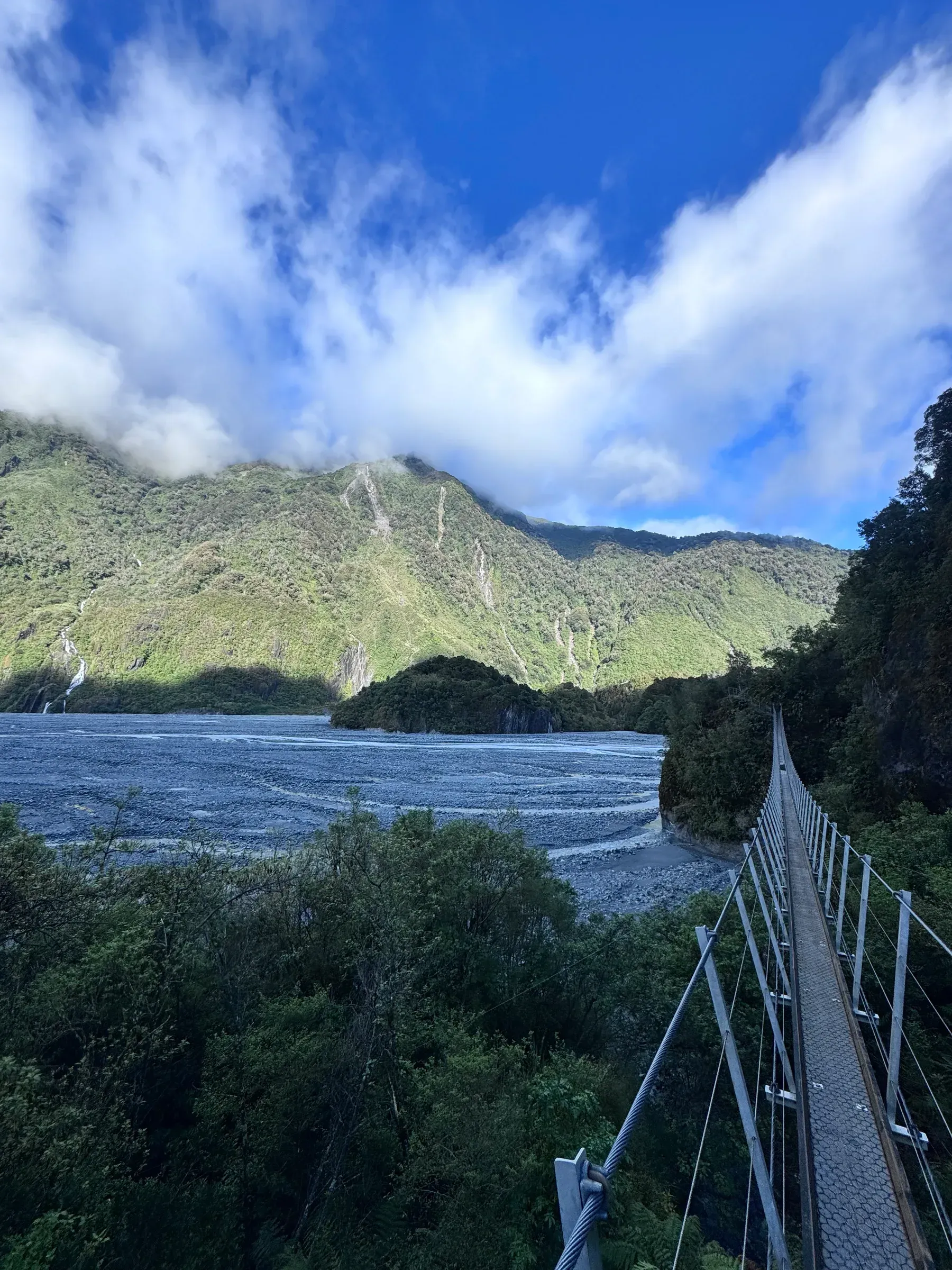
The next morning we set out to explore Franz Josef Glacier, one of New Zealand's best-known glaciers. You can explore this impressive glacier on the West Coast of the South Island in different ways, with several walking tracks that lead you through rugged terrain toward the ice. Earlier that year I'd already hiked up a peak with a panoramic view over the glacier. This time we picked a different route that's just as spectacular: the Robert's Point Track.
The Robert's Point Track is easily one of the most beautiful walks in New Zealand. It's about 10 kilometers round trip and takes you through dense rainforest, along riverbeds and over swing bridges. It ends at a stunning lookout with views of the Franz Josef Glacier and the mountains around it. If you love hiking and want to really experience New Zealand's nature, this one is a must.
Keep in mind that the Robert's Point Track is a fairly challenging hike. You'll want a decent level of fitness, since some sections involve climbing and scrambling. After rain the track can also be slippery and muddy, so good hiking boots, rain gear and plenty of water are essential. Come prepared and you'll be rewarded with one of the most impressive nature experiences of any New Zealand road trip.
Franz Josef – Hokitika Gorge
After our morning hike at the glacier, we took our time driving toward Hokitika Gorge in the afternoon. It was already getting dark by the time we got there, so we decided to visit the gorge the next morning instead. We didn't regret that for a second.
A night behind a local pub
We'd arranged to spend the night at a spot behind a local pub in a small farming village near Hokitika. Personally, I thought it was a fantastic place. When we walked into the pub, a few pretty rough-looking locals were sitting at the bar. Iris and Thijs gave each other a look that said, "Where on earth have we ended up?" I, on the other hand, felt right at home and decided this was exactly where we wanted to stay.
It turned out to be a great call. We had practically the whole place to ourselves, with clean showers and restrooms and even a cozy little kitchen to cook in. The owner was incredibly friendly and welcoming. The place sits in the middle of quiet farmland, surrounded by paddocks of grazing cows. That raw, authentic New Zealand feeling is exactly what makes a campervan trip so special.
Hokitika Gorge
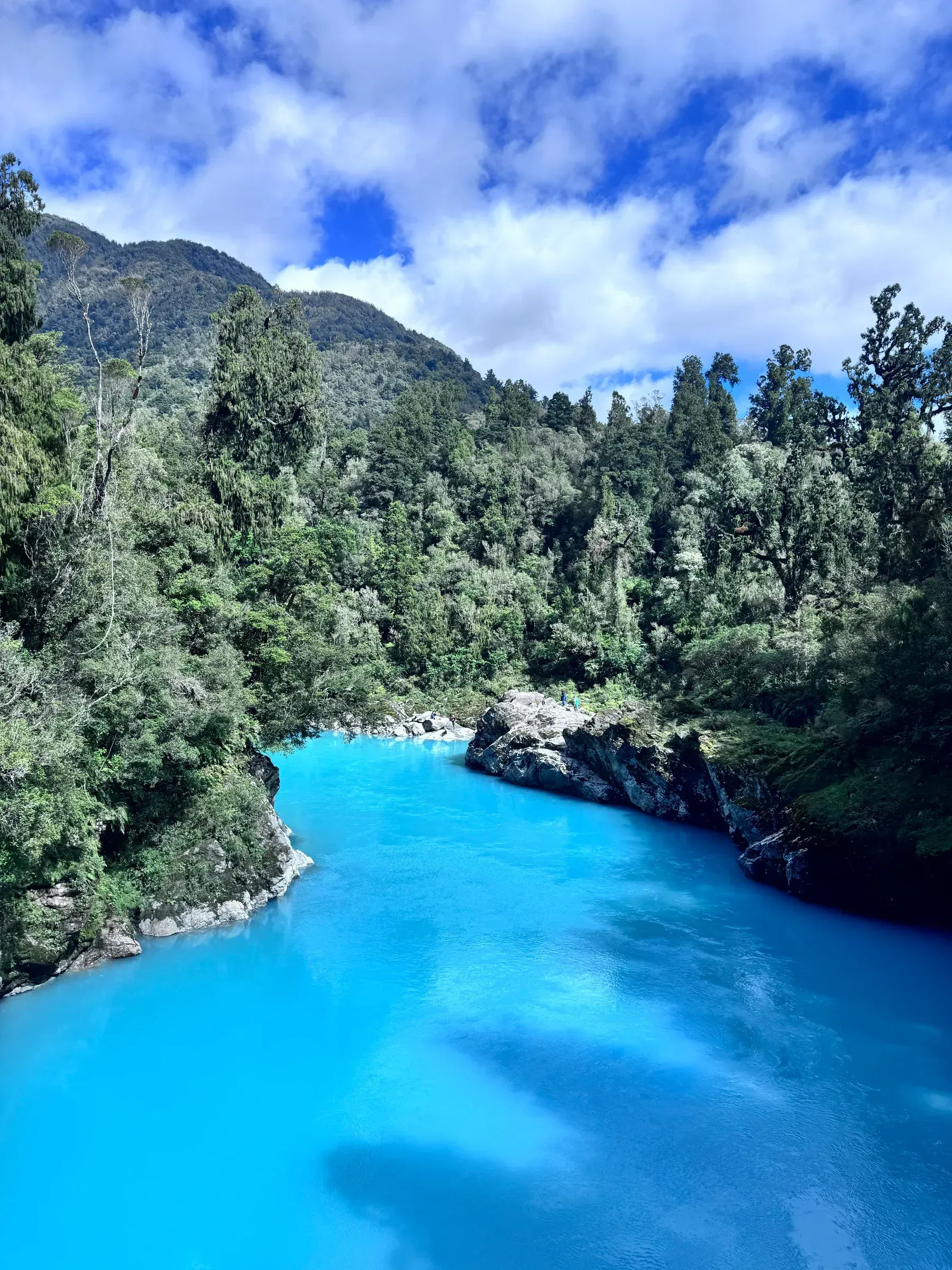
The next morning we drove out to Hokitika Gorge early. I'd been here before on an earlier road trip, but it's so impressive that it's well worth a second visit. There's a short walking track around the gorge that takes about an hour, including stops.
The water here is intensely blue and crystal clear, a color you won't believe until you see it for yourself. On a sunny day the gorge looks like it's full of sparkling diamonds. When it's warmer you can also swim here. Just know that the water is pretty cold, even on warm days in early summer. Toward the end of summer, a swim is a lot more pleasant.
Why this stop is perfect for a campervan trip
A quiet night in a local village combined with a natural highlight like Hokitika Gorge makes this part of the route ideal if you're renting a campervan in New Zealand and want to explore the West Coast at a relaxed pace. The drives are short, there's nature all around you, and you get to see the real, unpolished South Island. That's exactly what a campervan road trip is all about.
Hokitika Gorge – Punakaiki
After Hokitika Gorge we drove straight on to where we were staying that night: Punakaiki. On the way we passed through Greymouth, where we walked around a bit and checked out a few shops. Fine for an afternoon, but otherwise we didn't think it was anything special.
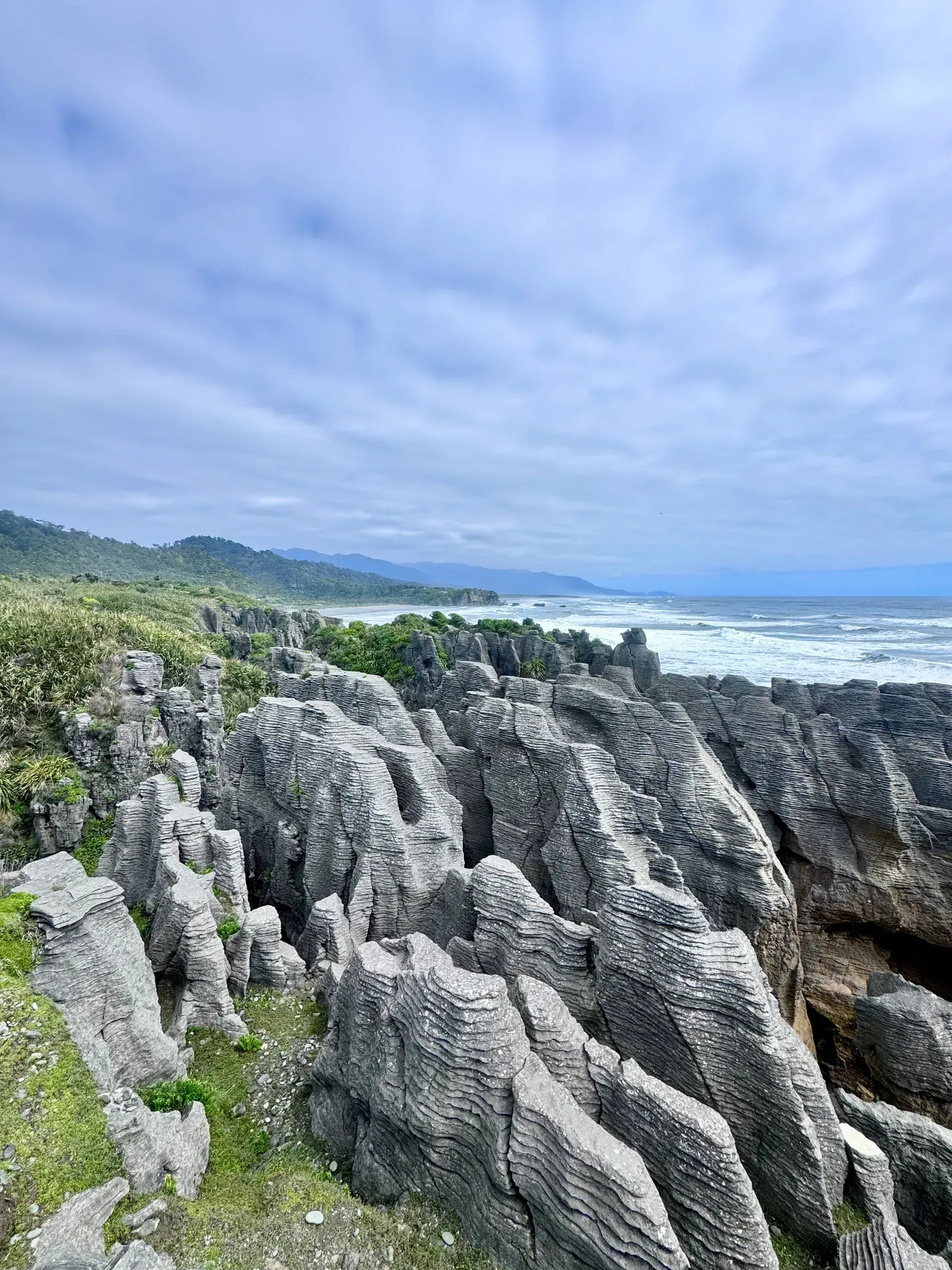
Once we got to Punakaiki, we took a short late-afternoon walk to the 'Pancake Rocks'. There's plenty of parking at the start, and the walk itself takes no more than 45 minutes, photo stops included. The Pancake Rocks, which are around 30 million years old, formed as layers on the seabed and were eventually pushed up by seismic activity. Very impressive.
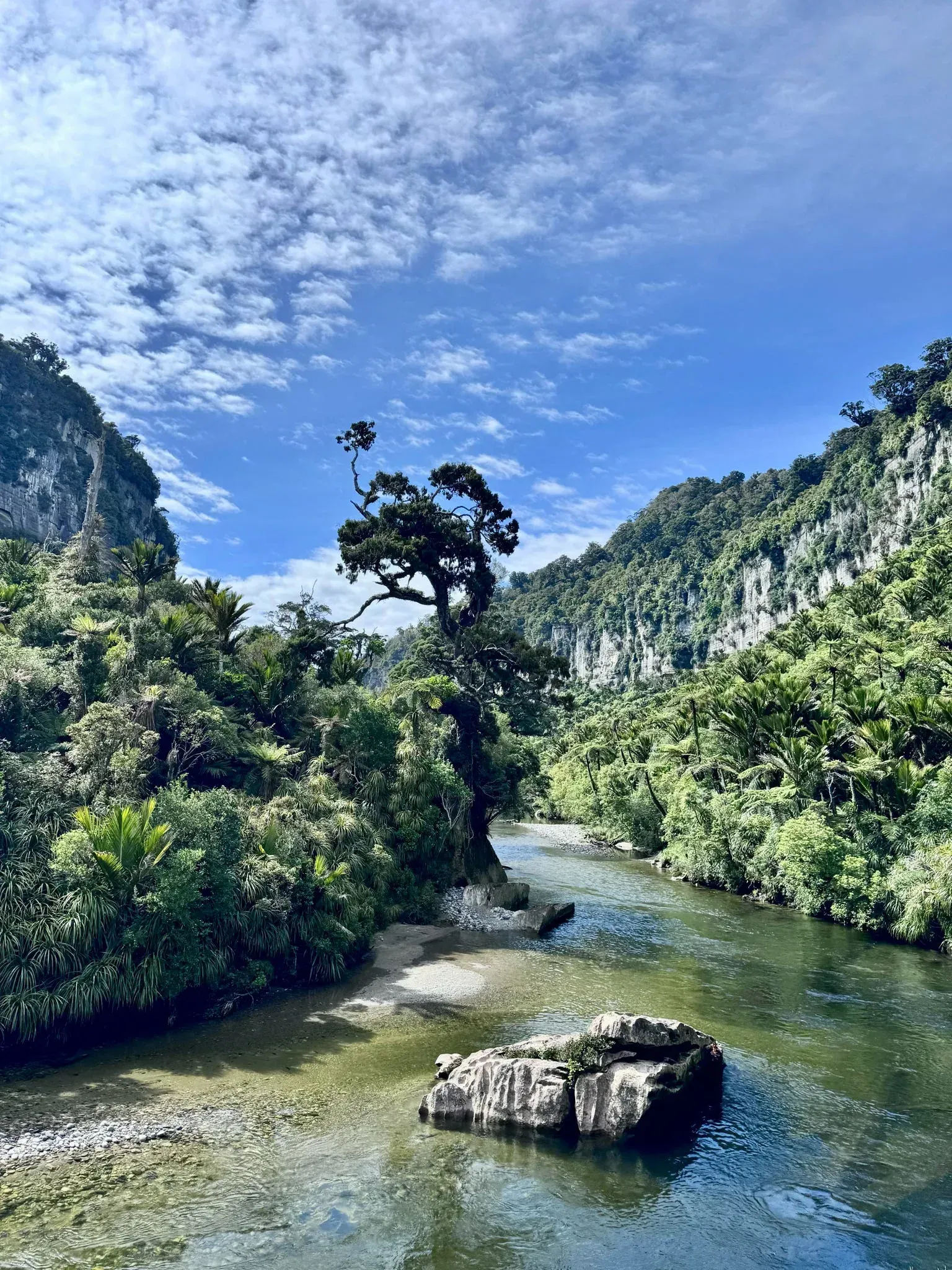
Punakaiki Beach Camp, where we stayed that night, is right on the ocean, and it's where you'll see the best sunset in New Zealand. It's a beautiful campground with roomy sites and lots of greenery. After a slow start the next morning, we walked the Pororari River Track, an easy but very beautiful 6.4 km walk along the Pororari River through gorgeous coastal rainforest.
Punakaiki – Abel Tasman National Park
Once we'd done everything we wanted around Punakaiki, we drove north toward the top of the South Island to visit Abel Tasman National Park. We broke up the drive with a night at Quinny's Bush Camp. It's a really nice campground in the middle of the forest, though it's right on the main road. When we were there it was nice and quiet, but it's very much aimed at families with kids. Want to avoid that? Then skip weekends and school vacations.
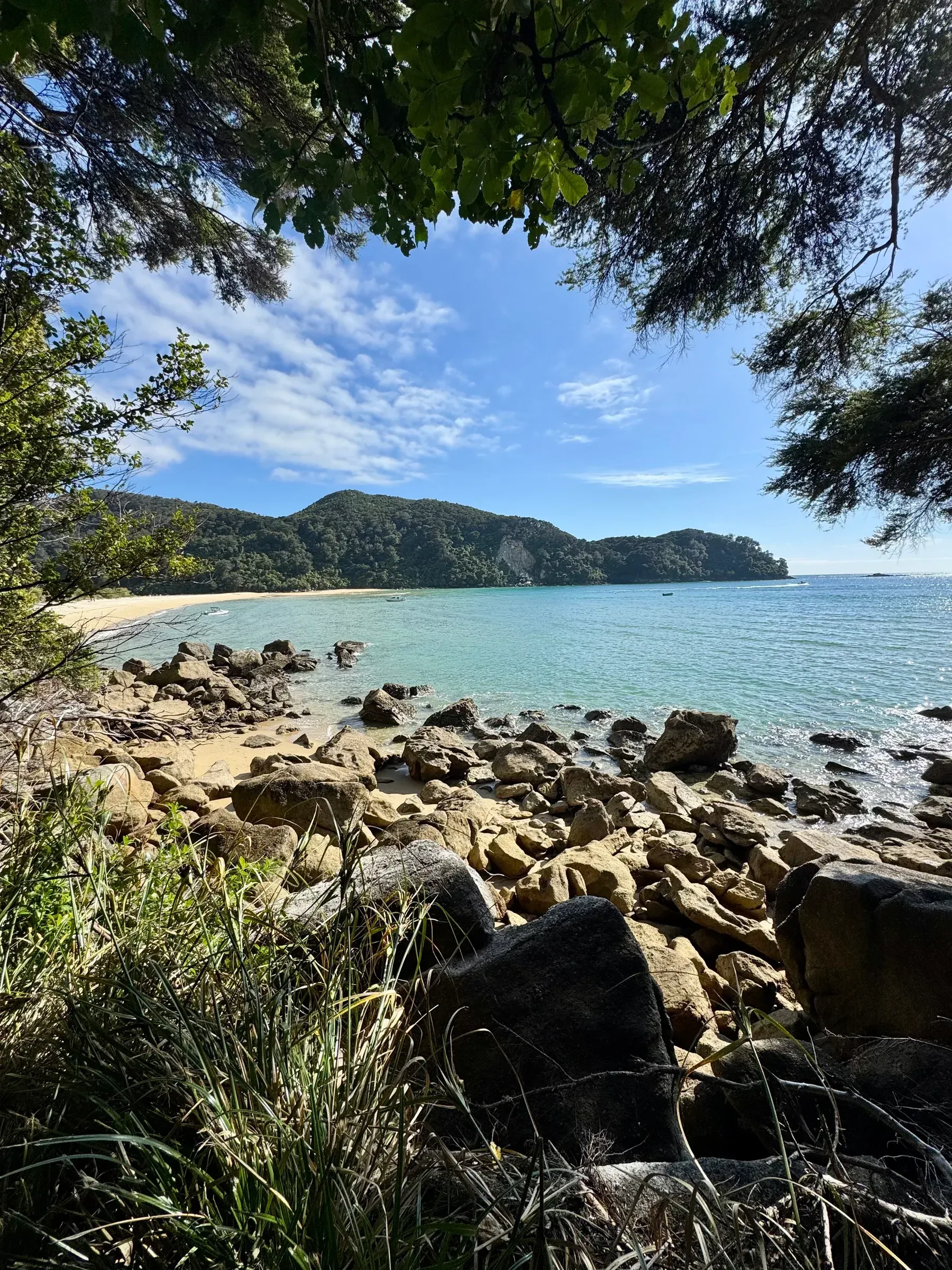
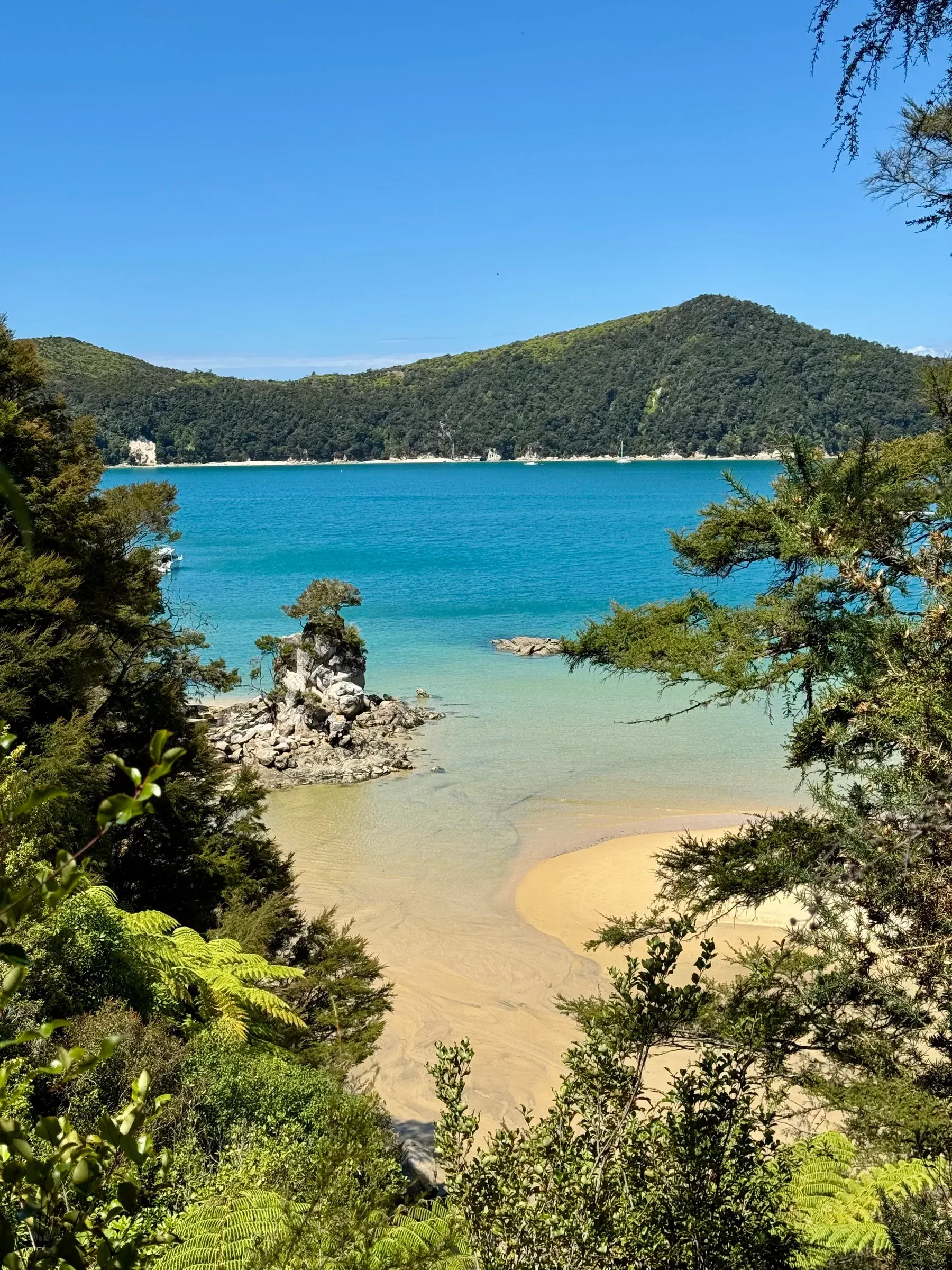
The next day it was only a two-hour drive to Abel Tasman National Park. This is where Abel Tasman, the first European to discover New Zealand, came ashore in 1642, at the spot now called 'Golden Bay'. Abel Tasman National Park is known for its beautiful golden beaches, its turquoise water and the famous Abel Tasman Coastal Track. On my earlier road trip I stayed on the east side of the park at a campground called 'Old Macdonald's Holiday Park', a lovely green spot next to a river you can swim in. From there it's easy to catch a water taxi to different points along the coast and walk back.
Hiking in Abel Tasman National Park
After a good night at Quinney's Bush Camp, we were up early on the morning of day 13. We packed up the campervan and drove straight to Abel Tasman National Park, all the way around to the northwest side. That's where you'll find the Waihui parking lot, the start of our hike for the day.
Inland & Coast Loop Track via Gibbs Hill
The hike we'd picked is called the Inland & Coast Loop Track via Gibbs Hill. This impressive loop is about 24 kilometers long and gives you the best of both worlds: one stretch through dense forest and another along the rugged coastline. It takes you through a beautiful and fairly quiet part of Abel Tasman National Park, with views of the ocean, golden beaches and green hills. On a sunny day especially, it's one of the most beautiful hikes in the region. As stunning as it is, the terrain isn't flat. The trail is quite steep in places, so a good base level of fitness definitely helps.
We set off around 10:30 a.m., and in the end it took us about five and a half to six hours. By late afternoon we were back at the parking lot.
Abel Tasman Coastal Track & Great Walks
This route is part of the famous Abel Tasman Coastal Track, one of New Zealand's nine official Great Walks. That alone explains why the area is so popular with hikers from all over the world.
Earlier that year I'd already walked a different section of the track. That time a water taxi dropped me off halfway, at Bark Bay, and I walked back to the starting point at Marahau. That was also about 24 kilometers.
The full Abel Tasman Coastal Walk is about 60 kilometers in total, but the great thing is that it's easy to split up. You can walk different sections at different times, depending on your schedule and fitness. Marahau and Waihui are the two ends of the track.
After the hike we drove straight to our next stop for the night: Hack'n Stay Golden Bay. After a quick check-in, we hopped back in the campervan and went to dinner at The Mussel Inn, a cozy restaurant just a five-minute drive away.
This place is well worth a visit: tucked away among the trees, with delicious food and a great lineup of local beers. The perfect place to recover after a long day on your feet.
After dinner we drove back to the campground and went to bed early. Tired legs, big smiles, and another amazing day in New Zealand behind us.
Abel Tasman National Park – Nelson
After a relaxing night, we took it slow the next morning. We slept in, packed up the campervans and drove to Takaka, a charming little town in Golden Bay known for its laid-back vibe and great places to eat.
In Takaka we stopped at The Wholemeal Café, a must for breakfast or a good cup of coffee. It's bright and open, with a clear '60s and '70s influence in both the decor and the music.
The staff were super friendly and the food was excellent. A perfect place for a relaxed start to the day before you head on.
Before we got to Takaka, we made a quick stop at Te Waikoropupu Springs. It's a short, easy walk past several natural springs.
On a sunny day the colors of the water are spectacular: incredibly clear and an almost unreal blue. These springs are some of the clearest freshwater springs in the world and truly one of a kind in New Zealand. A short stop that's absolutely worth it.
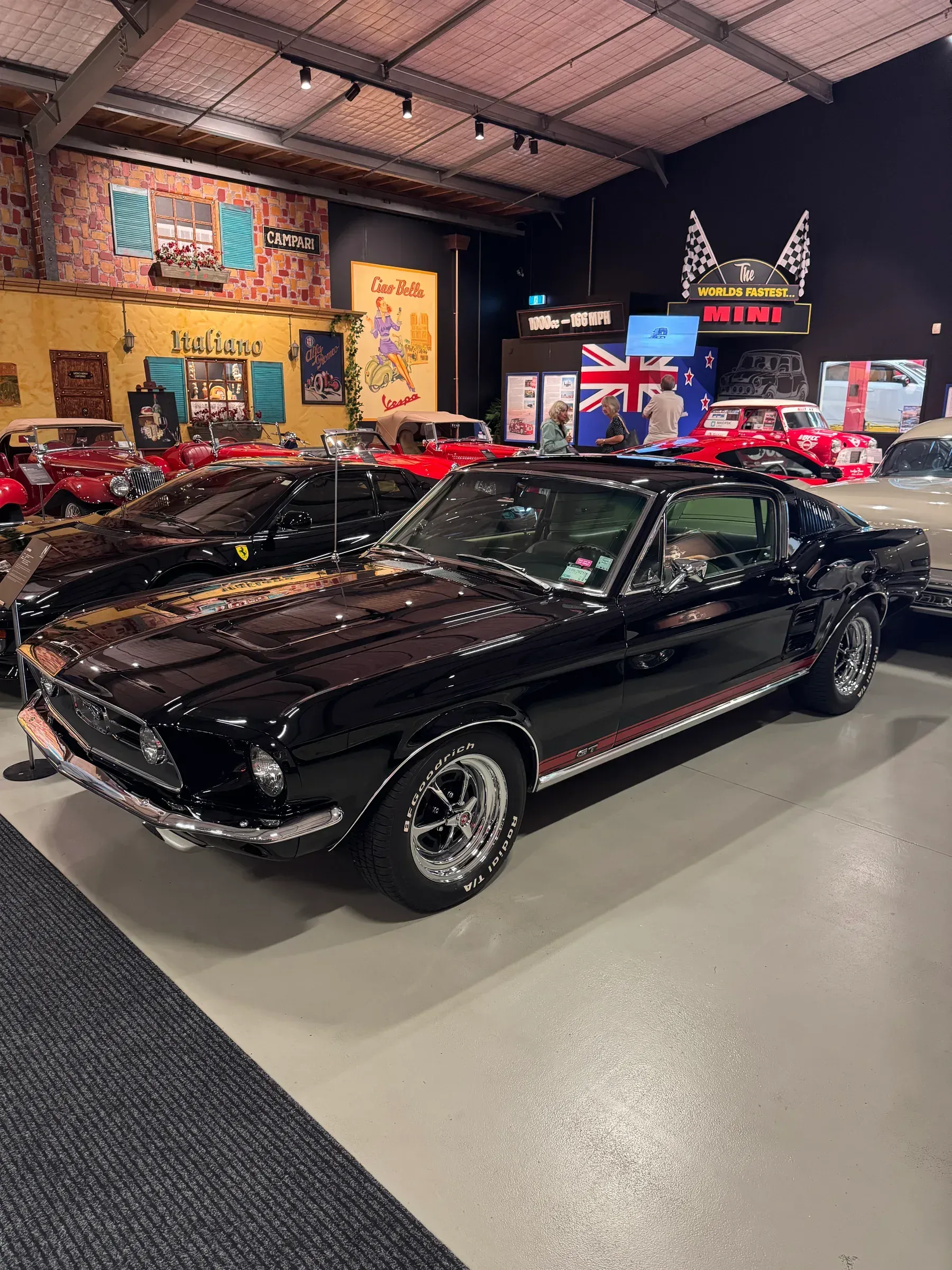
After breakfast and sightseeing we drove on to Nelson, where we visited the Nelson Classic Car Museum. If you love cars, this is a must.
The museum is much bigger than you'd expect. I'd pictured around 60 to 70 cars, but there turned out to be more than 200. Everything from the very first car ever built to modern Formula 1 cars, and everything in between. It's hands down the best car museum I've ever been to.
After Nelson we drove on to our next stop for the night: Cable Bay Holiday Park Nelson, on the north side of the city, outside the center.
This campground is set in beautiful green surroundings and is one of the best ones we stayed at in New Zealand. What makes it extra fun is that all kinds of farm animals roam freely around the grounds. Always a treat to see.
In the evening we cooked dinner at the campground and went to bed early, ready for another day of exploring.
Nelson – Picton, via the Queen Charlotte Drive
The next morning we got up early and hit the road right away. Along the way we found a great little café called The Coffee House, the perfect place to stop for your first coffee of the day. It's literally on the side of the road in a small village, on the left-hand side, so keep your eyes open as you drive through.
After the coffee stop we drove on to Pelorus Bridge, a beautiful spot surrounded by nature. You can take a short, easy walk here along the Hoiere River. The river is extra special because scenes from The Hobbit were filmed here, including the famous barrel scene where the dwarves float down the river. Even if you're not a big movie fan, it's a nice place to stretch your legs and take in the scenery.
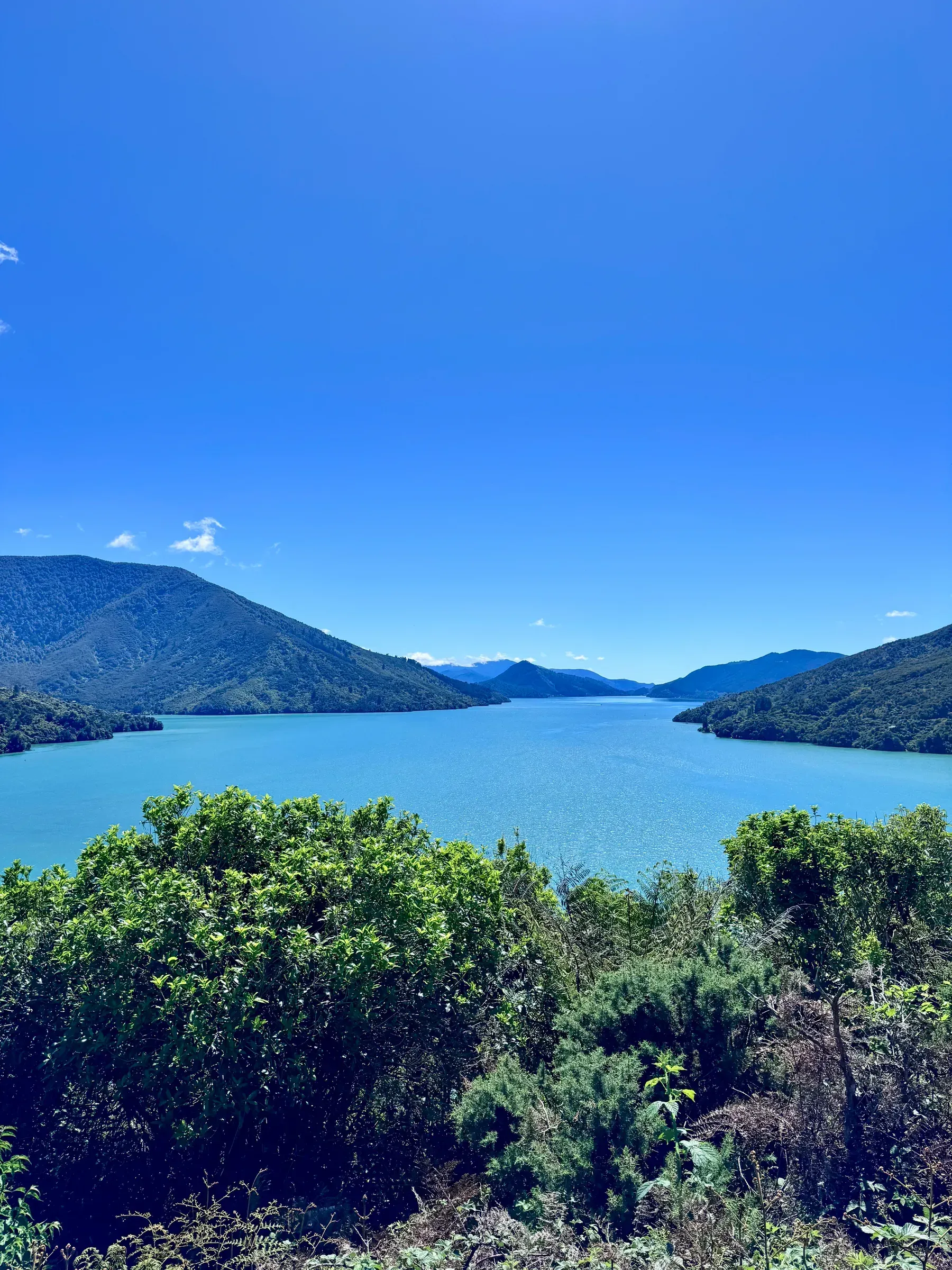
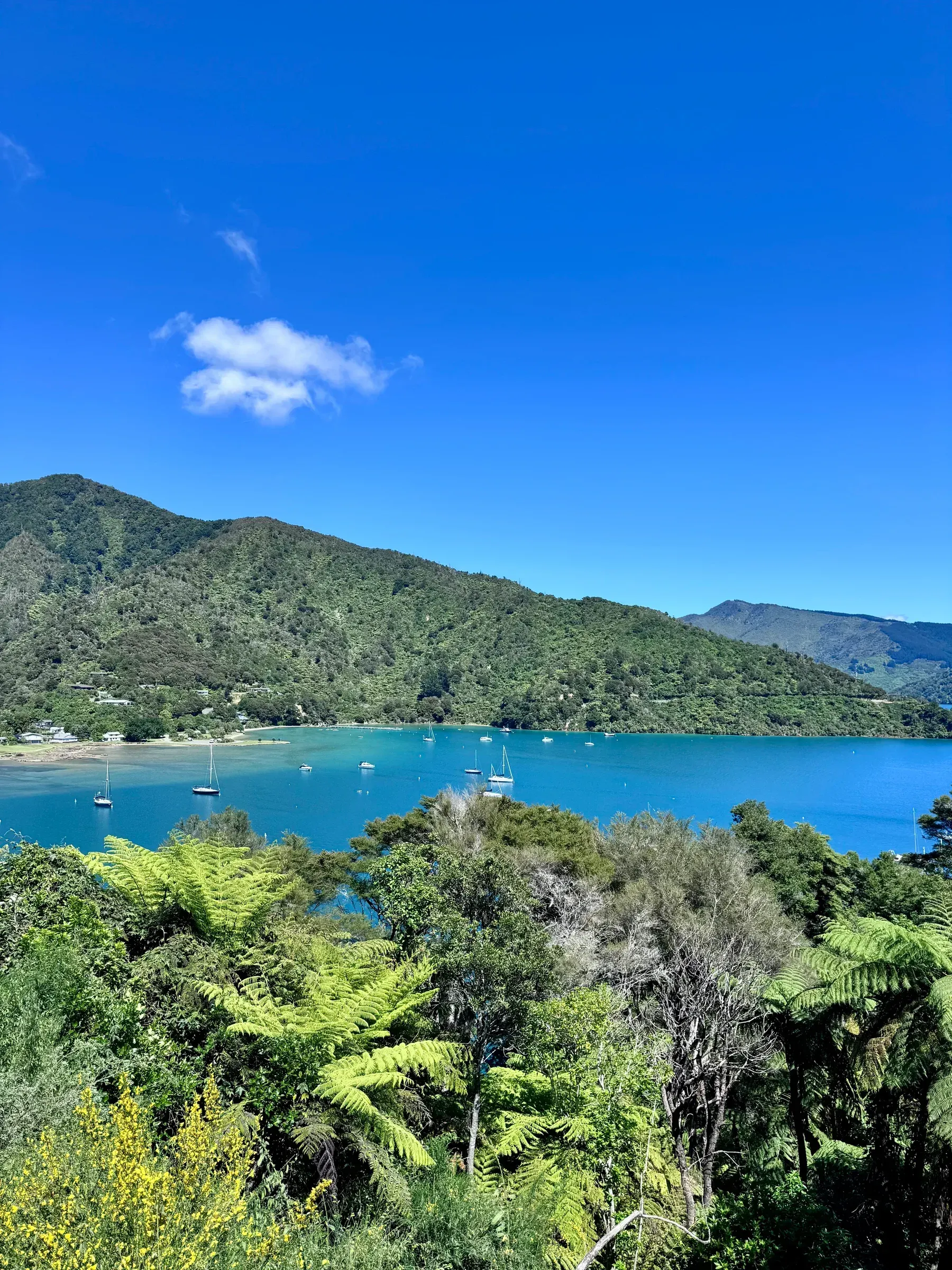
After a short walk we continued toward Picton. For this stretch we chose the Scenic Queen Charlotte Drive on purpose, and I highly recommend it. The road winds along the water, with beautiful views over the fjords and bays in lots of places. Take your time here, because you'll want to keep stopping for photos.
We got to Picton around lunchtime. Since we had to catch the early ferry to the North Island the next morning, we spent the night at a campervan site in town. In the afternoon we did a half-day wine tour with Sound Connection, about four hours in total. We visited four different wineries in the Marlborough region and finished at a chocolate shop. I'll let the wineries be a surprise; the standard here is very high. Our guide, a friendly older man named Andy, talked about the region and the wines with so much enthusiasm that it made the tour even better.
In the evening we went out to dinner at The Barn & Grill in Picton, a charming restaurant with a distinctly American feel and a relaxed atmosphere. The food was very good, the perfect end to a great day.
Picton – Wellington
Our time on New Zealand's South Island was over. We'd had two fantastic weeks there and could easily have stayed a lot longer. We left early in the morning for the ferry so we'd get to Wellington around midday.
The crossing itself is gorgeous, especially on the Picton side, where you sail through the fjords of the Marlborough Sounds. On a sunny day the views are seriously impressive. To me, this ferry ride isn't just a way to get from A to B; it's a highlight of your New Zealand road trip in its own right.
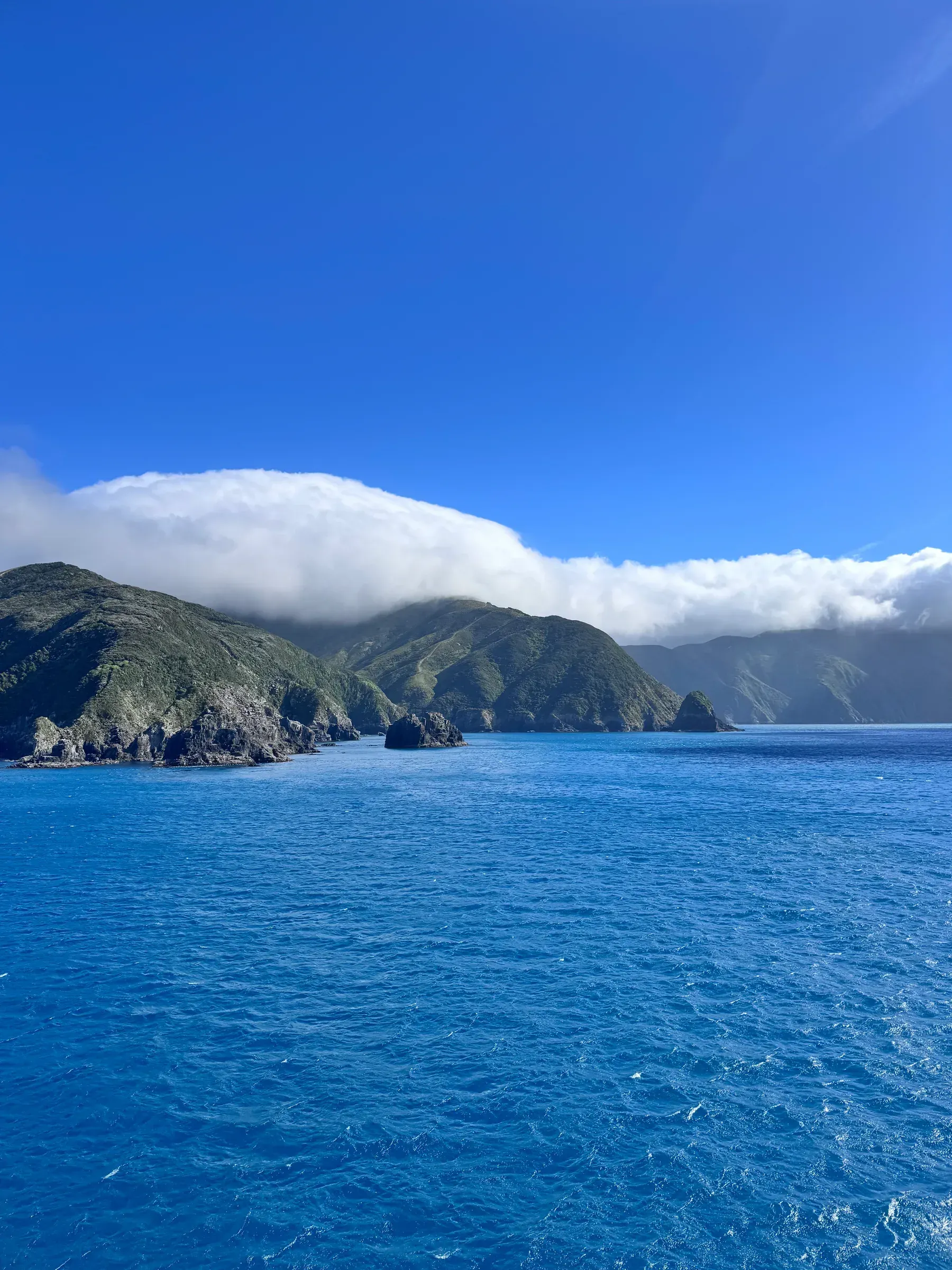
We spent one night in Wellington, at Evans Bay Marina Self Contained Camping. It's free, right on the water, and has two well-kept restrooms that are cleaned daily. Downtown Wellington is about a 45-minute walk away, and there's also a good bus connection. A nice, quiet place to spend the night in your campervan after the ferry.
Once we'd parked the campervans, we walked up Mount Victoria to see some well-known Lord of the Rings filming locations. Among other things, we saw the spot where the four hobbits hide from the Nazgûl under a tree root, the path they walk along just before that, and the tree where Frodo is reading at the start of the extended edition of the first movie.
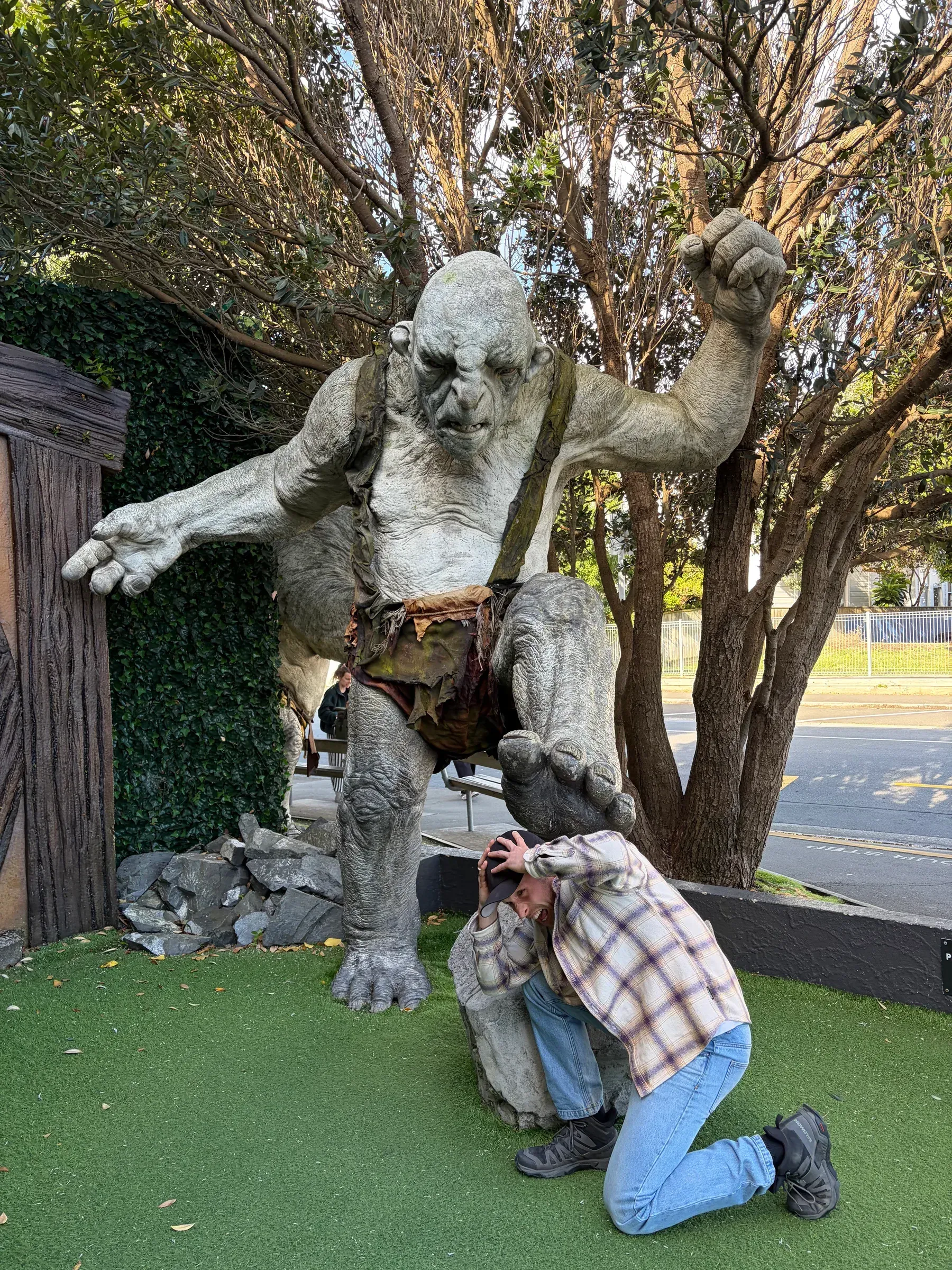
After that we had a tour booked at Weta Workshop, easily one of the highlights of our whole New Zealand road trip. This studio made the props, costumes and special effects for The Lord of the Rings and countless other well-known movies. It's incredible to see how much craftsmanship, technique and time goes into it, and how different it is from relying on CGI alone.
After the tour we headed downtown for food and drinks. We started with a beer and some snacks at Garage Project, a small, super cool brewery in an industrial warehouse right in the city. For dinner we found a table at a small local Vietnamese place, and we wrapped up the night with live music and a few beers at The Rogue & Vagabond.
Wellington – Tongariro National Park
Before leaving Wellington, we spent the morning at the Museum of New Zealand Te Papa Tongarewa. This national museum is absolutely worth it if you want to learn more about New Zealand's history, nature and native wildlife. It also covers Māori culture in depth, which makes it a great introduction before you travel on through the North Island.
Toward the end of the morning we got back in the campervan and started the drive of about 4.5 hours to Tongariro National Park. About 45 minutes outside Wellington we made a quick coffee stop at The Roastery Espresso Bar in Paraparaumu. With a good coffee in hand, we had plenty of energy for the rest of the drive.
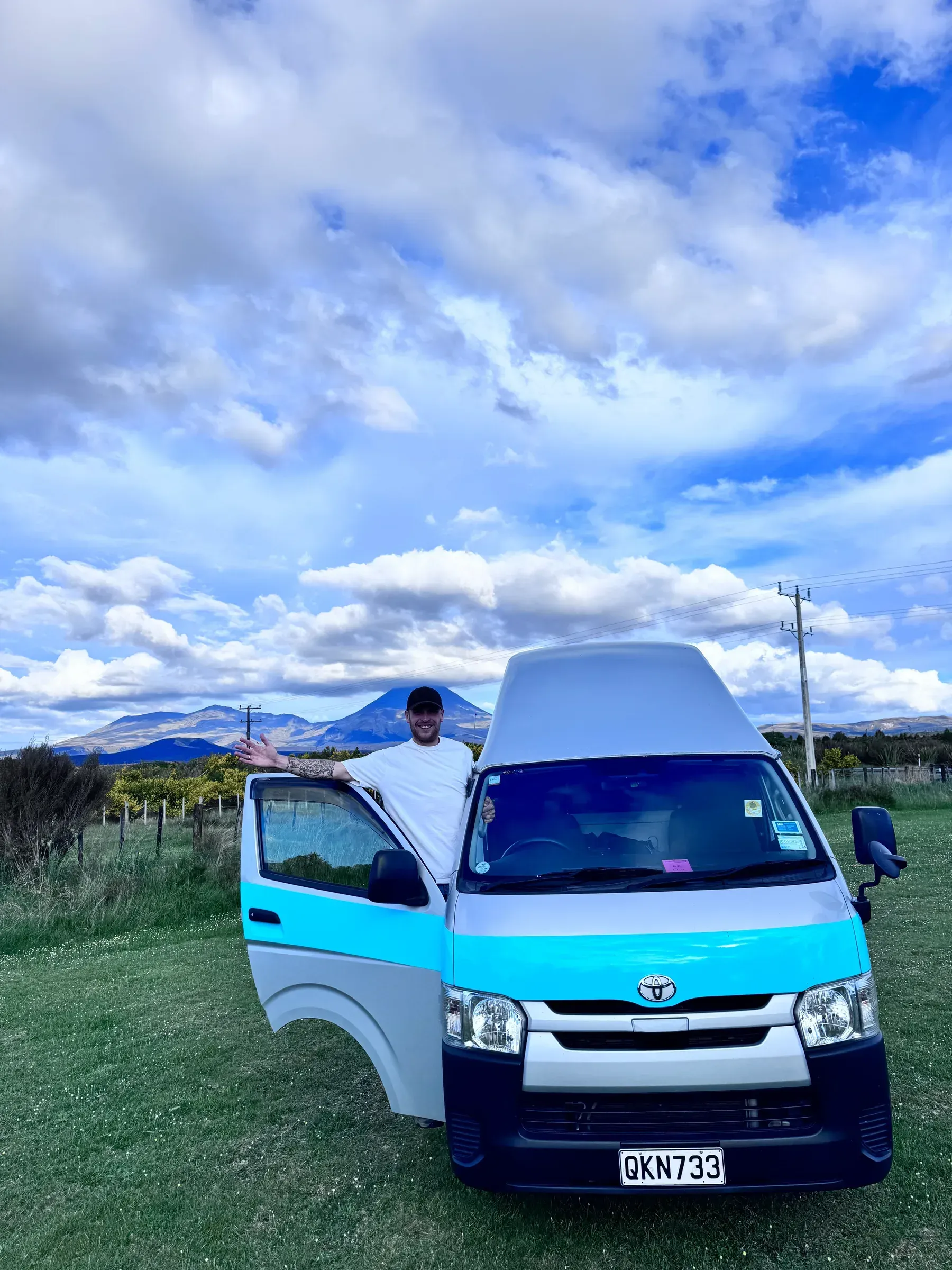
In the late afternoon we arrived in Tongariro National Park, one of the most impressive natural areas in the country. We stayed at Discovery Lodge Tongariro, a nice, affordable campground with lots of greenery and a relaxed vibe. The location is ideal, because the lodge is close to the start of the famous Tongariro Alpine Crossing.
That iconic hike was on the schedule for early the next morning. Staying here meant we didn't have to drive far in the morning and could start one of New Zealand's most beautiful walks well rested.
Tongariro National Park – Waitomo Glowworm Caves
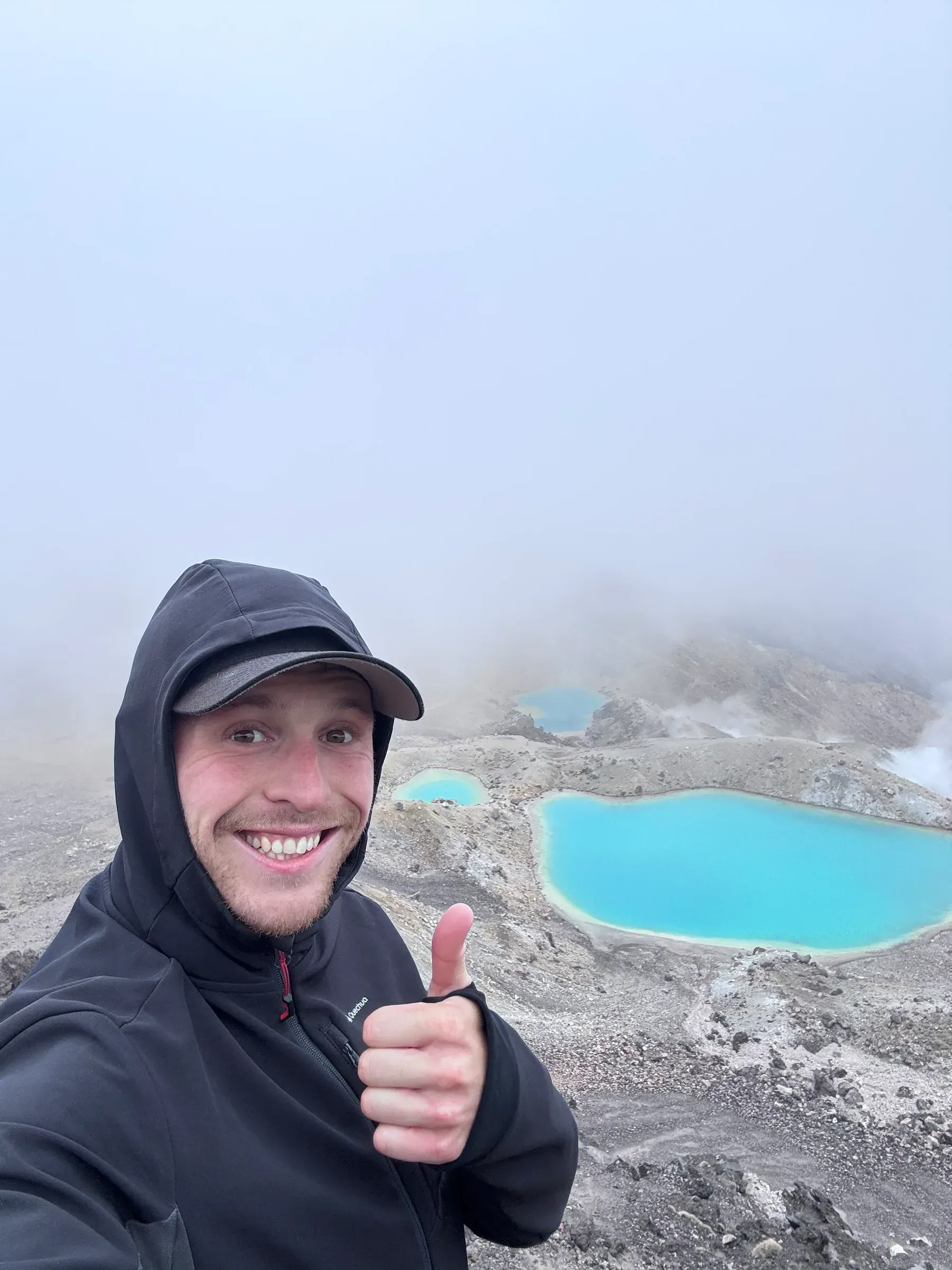
The next morning a shuttle we'd booked ahead picked us up early and took us to the start of the Tongariro Alpine Crossing. This 20 km hike takes you right across Tongariro National Park, and with the climb up Mount Tongariro it can be pretty challenging.
If you're fit and healthy, though, it's very doable in my opinion. Along the way you're rewarded with some of the most incredible views: rugged volcanic landscapes and brightly colored crater lakes. It's an impressive hike, and you also learn a lot about how the North Island formed, since most of it was created by volcanic activity.
The park is also sacred to the local Māori, which makes it extra special to be allowed to walk through it.
After the hike, which we finished in the late morning, we drove on from the campground, heading northeast. Our next stop was the Waitomo Glowworm Caves.
We spent the night nearby at a really great farmstay: Waitomo Farmstay. It's beautifully set among green rolling hills. There are animals wandering around everywhere, and you really get that authentic farm feeling.
Some people find the facilities basic, but personally I didn't mind at all. Once you've lived in the Australian outback, it takes a lot to faze you, haha.
Waitomo – Lake Taupo
The next morning it was only a 10-minute drive to the Waitomo Glowworm Caves. Discover Waitomo runs several different tours, and we went with Blackwater Rafting. You put on a wetsuit, grab an inner tube and head into the caves. In several places you float beneath thousands of glowworms, which is a magical sight.
There are also sections where you have to climb and scramble, and a few times you jump from a small height into the water to keep going. It's a really fun, active way to see the glowworms, and I definitely recommend it if you're fit and agile enough. There are also gentler tours, of course, so people of all ages can experience the caves.
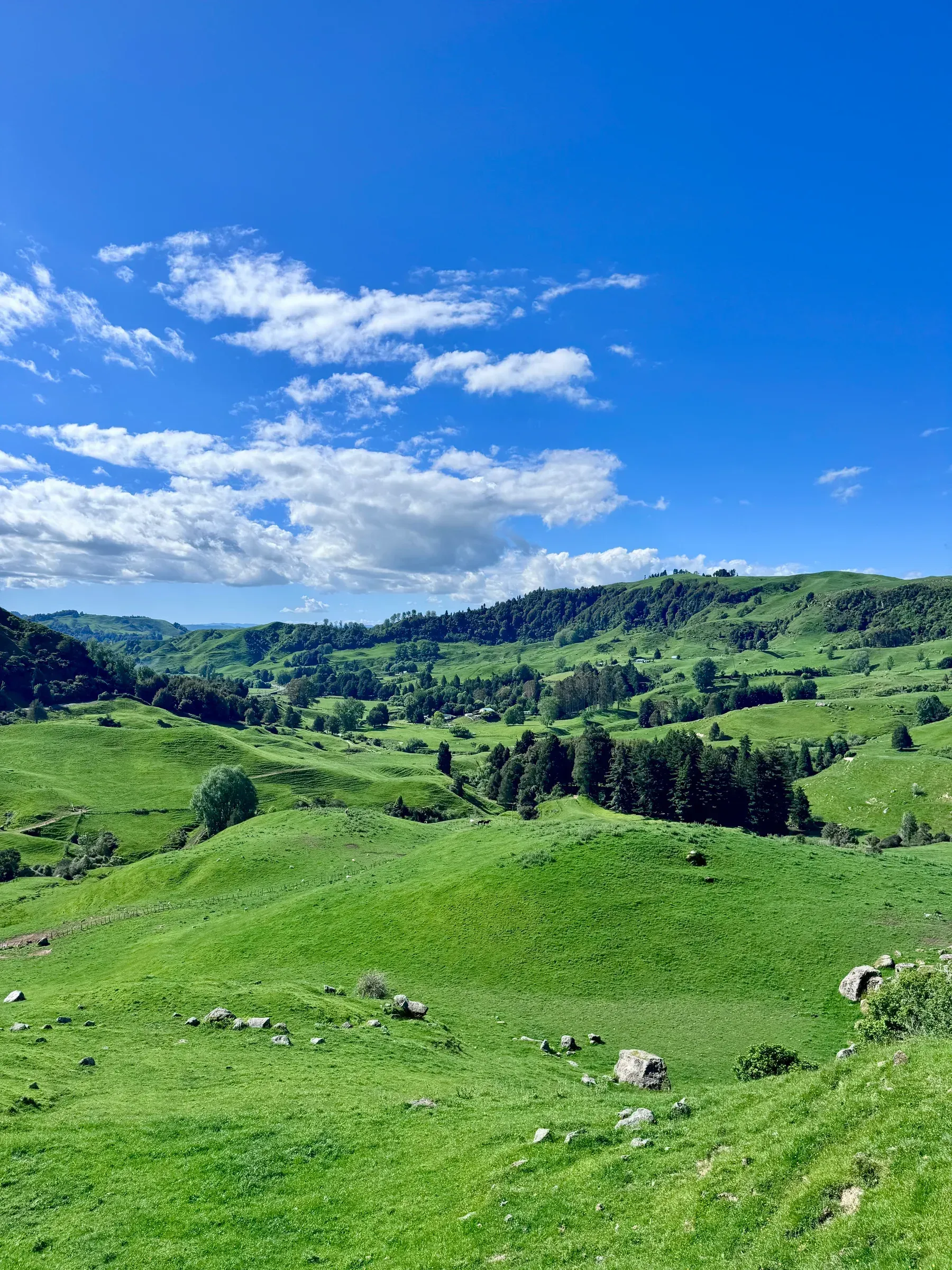
After lunch, which came with the glowworm tour, we drove on toward Lake Taupō. It's a beautiful drive through rolling green hills and fields full of flowers.
Near Taupō we stayed at a farmstay again: Wairakei Thermal Valley Campground. It was all three of our favorite campground of the whole trip. There was just one other campervan there, and you can literally park wherever you like. There are no set sites, and animals wander freely between the campervans: chickens, sheep, alpacas and even Danny the pig.
When we arrived, we first drove to Huka Falls. These falls are famous for their intensely turquoise water and the sheer force of the river being squeezed through a volcanic gorge just 15 meters wide. With around 220,000 liters of water rushing through every second, it's an impressive thing to see up close.
Afterward we walked around downtown Taupō a bit more and had dinner at Sorrento Italian Dining & Wine Bar, a cozy, authentic Italian restaurant with good, affordable food.
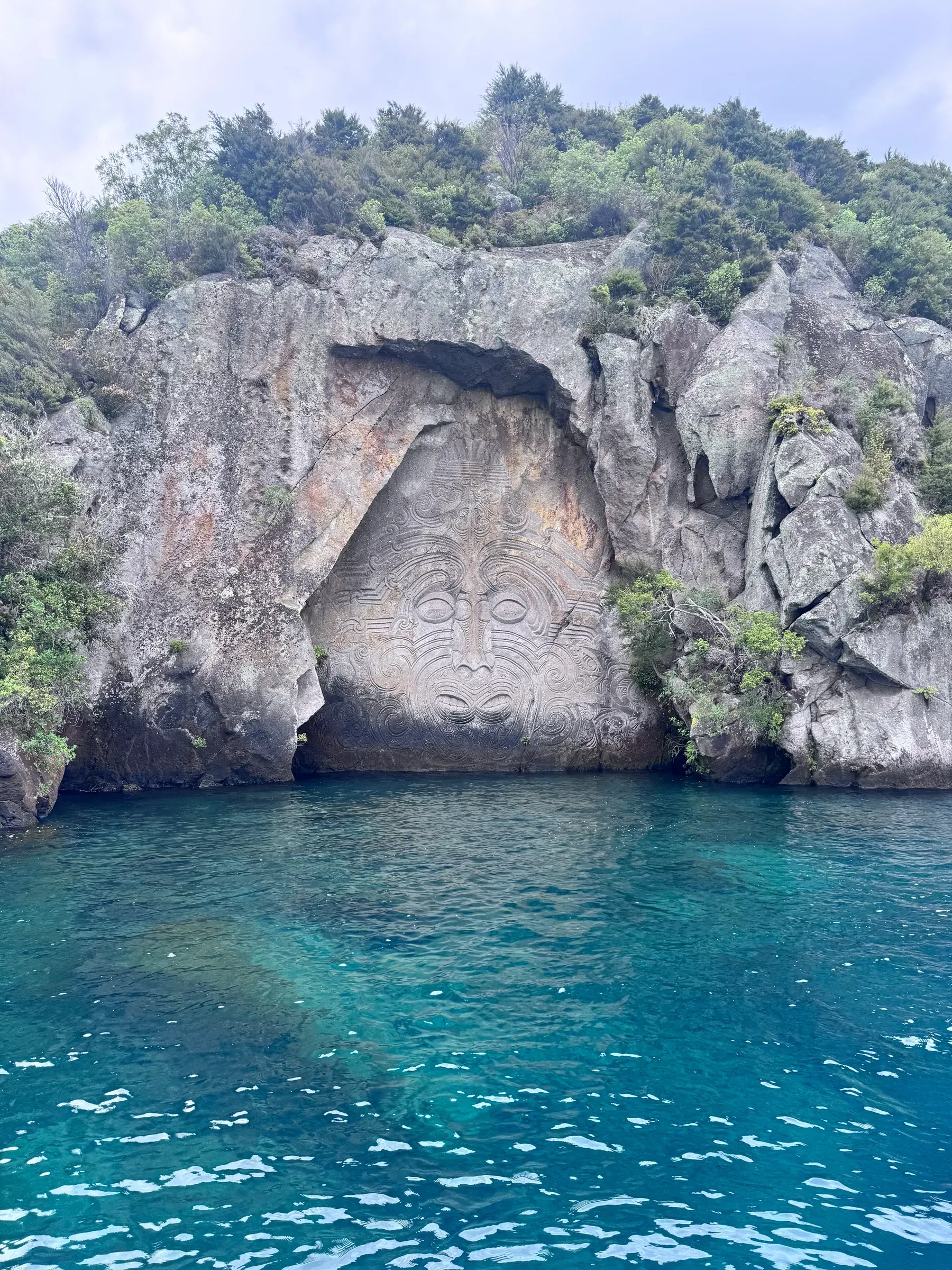
Taupō gets very touristy in summer and is especially popular for all the water sports on the lake. The weather was going to be beautiful the next day, so we booked a boat trip with Ernest Kemp Cruises. You cruise across the crystal-clear water of New Zealand's largest lake and visit the impressive 14-meter-high Māori rock carvings at Mine Bay.
On the way back there's often a chance to jump in the water, so if you're going on a warm, sunny day, don't forget your swimsuit. Back on shore, we made a delicious lunch by the campervans at a beautiful parking spot right on the lake. In the afternoon we stopped by the Huka Honey Hive. They have one of the biggest selections of 100% pure New Zealand honey and Manuka honey. It's not just honey, either; they carry all kinds of other local products too. Perfect for picking up a nice souvenir to take home.
Lake Taupo – Rotorua
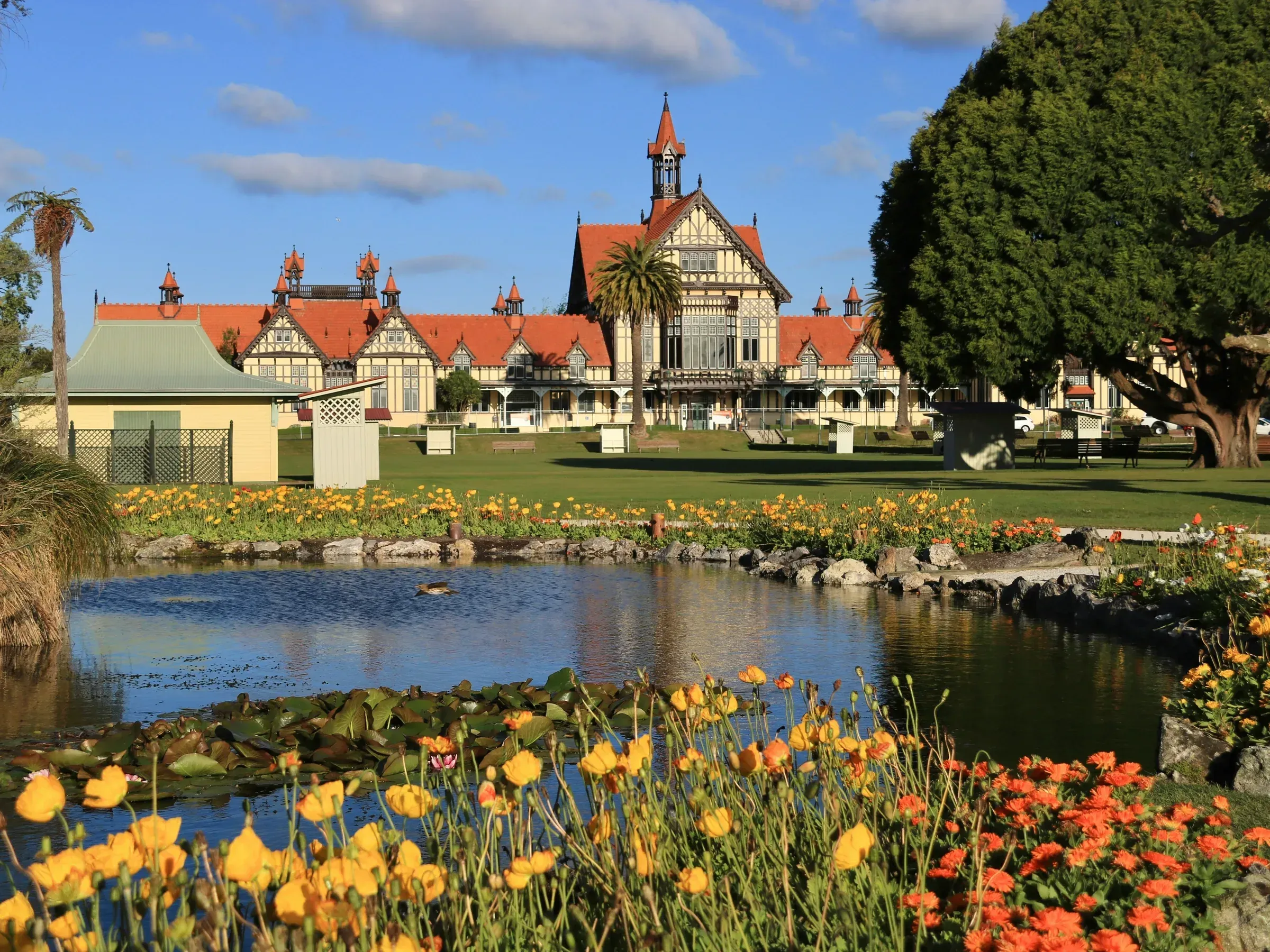
After two days in and around Lake Taupō, it was time to drive on to Rotorua. The city is known around the world for its impressive geothermal activity. Everywhere you look there are bubbling mud pools, steaming hot springs and spectacular geysers. The distinctive sulfur smell tells you right away that you're in an active volcanic area.
Rotorua is also a major center of Māori culture, with traditional villages, cultural shows and hāngi meals. And whether you're after action or relaxation, you're covered: the region is known for its mountain bike trails as well as its natural spas and hot springs. That makes Rotorua a great all-around stop on a road trip or campervan trip through New Zealand.
When we arrived in the afternoon, we started with a good cup of coffee and something to eat at Aroma Cafe. Then we strolled around downtown, where Iris and Thijs wanted to buy some souvenirs to take home.
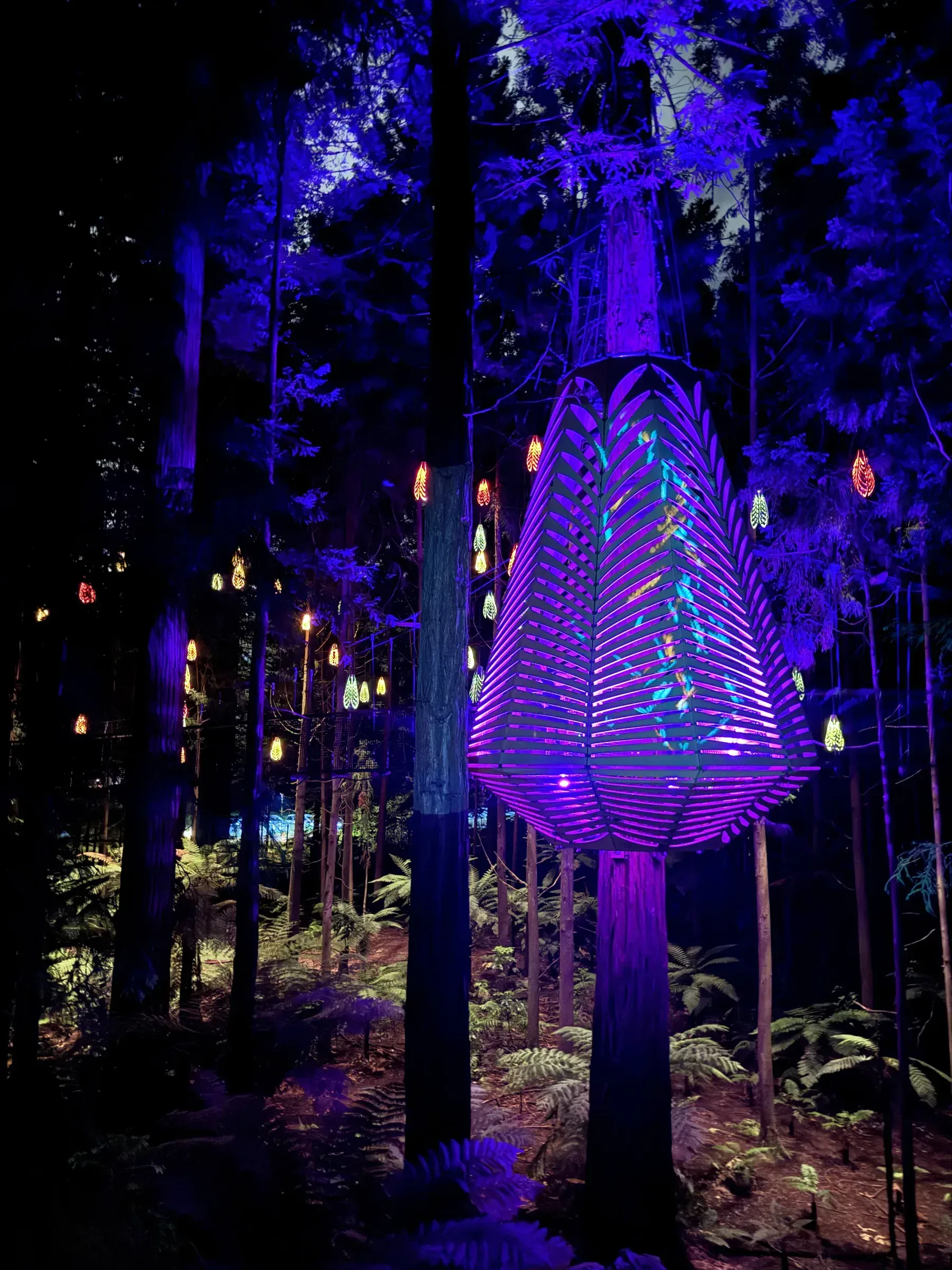
Once it got dark, we went to the Redwoods Treewalk. You can also do it during the day, but at night the whole forest is lit up in an artistic way. You walk across suspension bridges and platforms from tree to tree, following a route through the giant redwoods, surrounded by unique light installations. It's beautiful, although we thought the price of about NZD $40 was a bit steep, since during the day you can walk through the same forest for free on the regular trails. Still, it was a special experience and we didn't regret it.
The next morning we set off early to see the Lady Knox Geyser, which erupts every day at 10:15 a.m. When you buy a ticket for Wai-O-Tapu Thermal Wonderland, the geyser is included, so you can combine the two. Most visitors see the geyser first and then go into the park. That works fine, but if you want to enjoy the park while it's quieter, I recommend doing the park first. It opens at 8:30 a.m., which gives you about an hour and a half before you need to head to the geyser. In the park you'll find colorful, bubbling pools and volcanic landscapes that are constantly heated by geothermal activity.
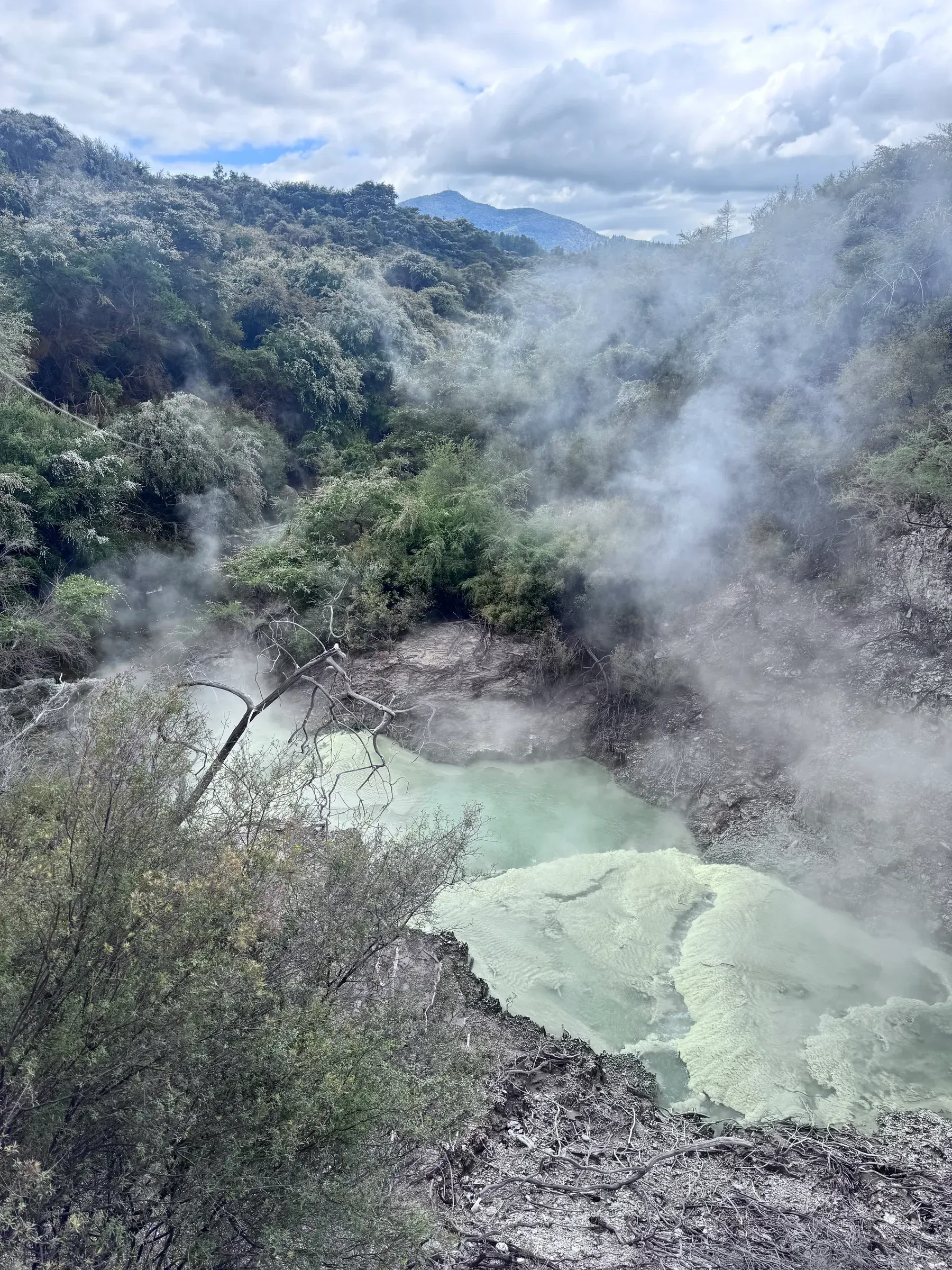
In Rotorua we stayed at Rotorua Thermal Holiday Park, an excellent campground where you can use the lovely heated thermal pools for free. We spent a relaxing afternoon there.
In the evening we wrapped up our time in Rotorua with a classic Māori experience at Mitai Maori Village. We chose the Mitai Māori Cultural Experience & Dinner Buffet. Over the evening you learn about Māori culture, watch traditional dance and eat a dinner cooked in a hāngi (a traditional underground oven). For us, it was one of the best cultural experiences of the trip, and absolutely a must on your New Zealand road trip.
Rotorua – Hobbiton Movie Set
- Movie Set Tour & Lunch Combo
- Second Breakfast Tour
- Evening Banquet Tour
- Behind The Scenes Tour
After Rotorua it was time for something we already knew would be one of the highlights of our New Zealand road trip: Hobbiton Movie Set. As huge Lord of the Rings fans, there was no way we were skipping Hobbiton.
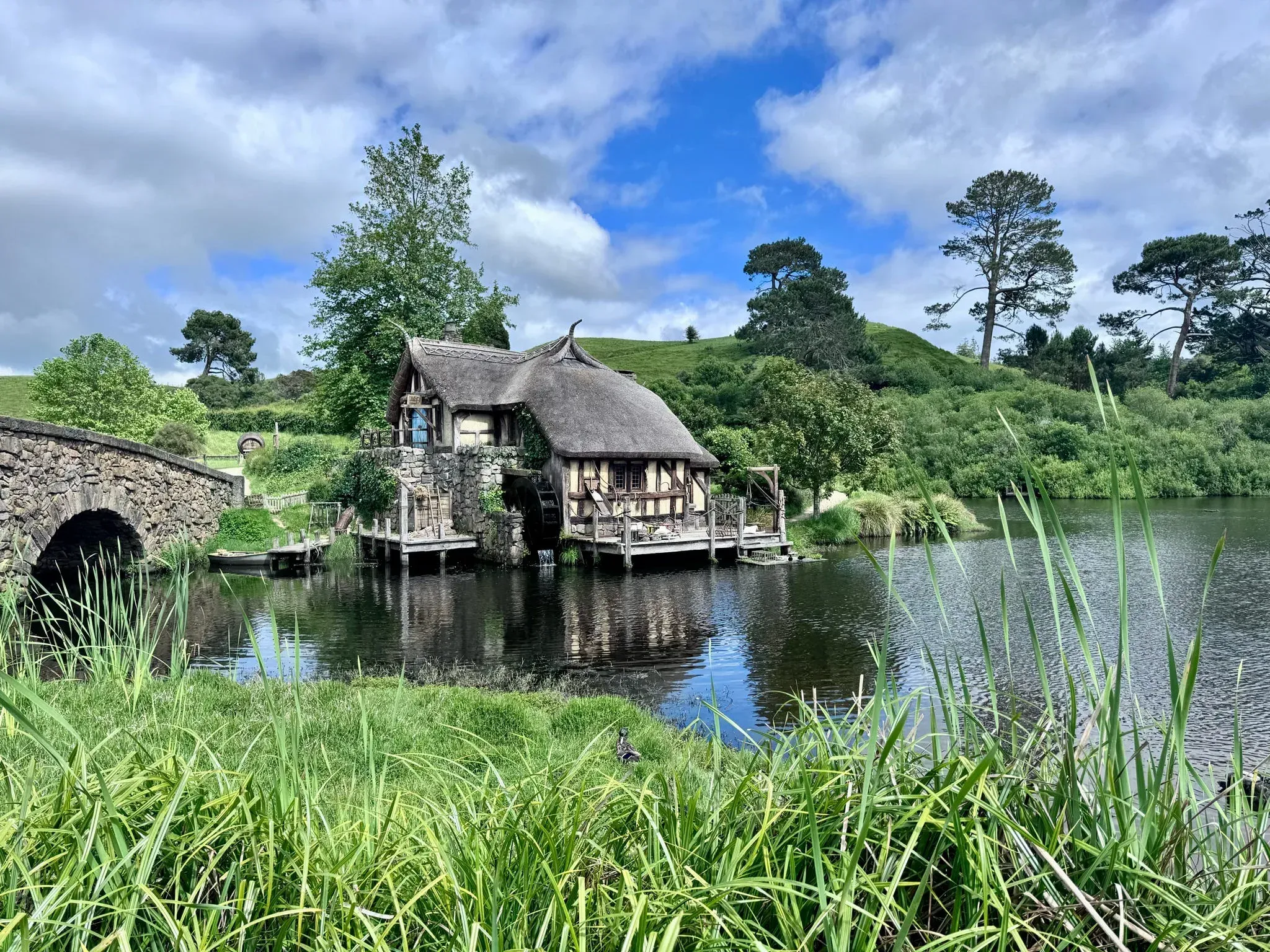
We'd booked the Second Breakfast Tour. On this tour you're one of the first groups into the park, and you finish the morning with a delicious brunch at The Millhouse, the iconic building from the movies with the waterwheel on the side. Because the tour starts early in the morning, we decided to drive toward Hobbiton the day before.
The day we left Rotorua, we took our time with a big breakfast at the campground. Toward the end of the morning we drove toward Hobbiton, stopping on the way at Te Waihou Blue Springs. We were lucky it was a sunny day, because just like at other blue springs, the bright blue water only really shines in the sun.
The full walk is about 4.7 km and takes around 3 hours round trip, but we only did the first section and were out for about an hour. That was more than worth it.
In the late afternoon we drove to our campground, just five minutes from Hobbiton. We stayed at Brock's Place Matamata, a really great farmstay on a hill with beautiful views. There are no animals wandering around, but you still get that peaceful farm feeling. It's small and personal, with room for maybe twenty campervans.
The next morning the moment had finally come: our visit to Hobbiton. We had the first tour of the day, so we had to be there at 8:30 a.m., and our tour started at 8:40 a.m. From the visitor center a bus takes you to the movie set in about ten minutes. On the way you already hear a bit about how Hobbiton came to be and why the place is so special.
Once we got there, we were blown away. What a beautiful setting, and it's incredible how much attention went into even the smallest details. We were lucky it was a sunny spring day, so everything was in full bloom. Since ours was the first tour through the park, there was almost nobody ahead of us, which was ideal for photos.
There are several tours you can book at Hobbiton:
Hobbiton Movie Set Tour: the classic tour of the 12-acre set, including a drink at The Green Dragon Inn.
Movie Set Tour & Lunch Combo: the standard tour followed by a lunch buffet in the Party Marquee.
Second Breakfast Tour: a morning tour where you're the first into the park. It ends with a big brunch at The Millhouse.
Evening Banquet Tour: a tour followed by a banquet at The Green Dragon Inn and a walk back by lantern light.
Behind The Scenes Tour: a premium tour for smaller groups (max. 28 people) with extra time and a meal at The Millhouse.
Are you a big Lord of the Rings fan yourself? Then I definitely recommend the Second Breakfast Tour or the Evening Banquet Tour. Book them a few months ahead, though, because they often sell out fast.
After the tour and a delicious brunch, the bus took us back to the visitor center, where we had a quick look around the gift shop. Among other things, you can buy the beers you tried earlier at The Green Dragon Inn here. Highly recommended.
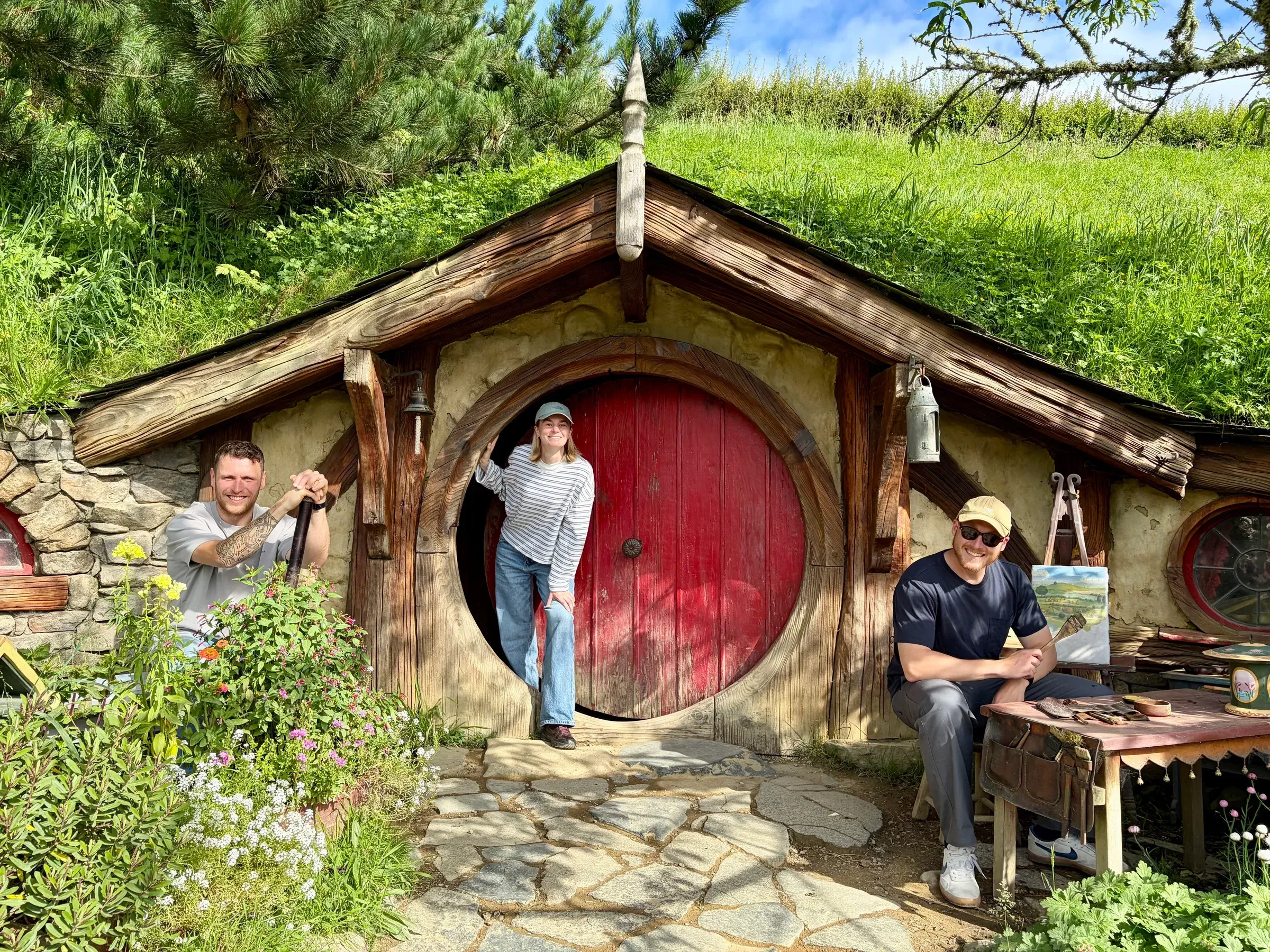
After Hobbiton I said goodbye to Iris and Thijs. They were going to keep traveling for a few more days, while I decided to spend a few days on Waiheke Island.
Hobbiton – Waiheke Island
- Postage Stamp Wines
- Stonyridge Vineyard
- Te Motu Vineyard
- Mudbrick Vineyard
After we said goodbye, I drove to Auckland, about two hours away. There I first returned my campervan, since you don't really need one on Waiheke Island. After dropping off my Barefoot campervan, I took an Uber to downtown Auckland, where the ferries to Waiheke leave from.
I'd booked my ferry with Island Direct, a smaller company with great service and boats that are a lot less crowded than the bigger options. The crossing takes about 35 minutes, so before you know it you're on Waiheke Island.
On the island I stayed at Waiheke Island Guesthouse, a really nice Airbnb where you get that classic Waiheke feel. It has a relaxed, almost hippie vibe and a beautiful garden where you can really unwind. It's also an easy place to meet other travelers.
Once I'd checked in, I walked to Waiheke Cycles, about 30 minutes on foot from where I was staying, to pick up my e-bike. The young owner is a super laid-back guy and very helpful. On top of that, his prices are a lot friendlier than at the bike rental places right by the ferry terminal.
That same evening I met up with some friends I'd gotten to know while I was living in Queenstown. We had a beer together and soaked up the relaxed island atmosphere.
The next two days I mostly did the same thing, just in different places each time: visiting wineries. Waiheke Island is known for its vineyards, and there are a lot of them. I rode my e-bike all over the island and visited both small family vineyards and bigger, busier wineries.
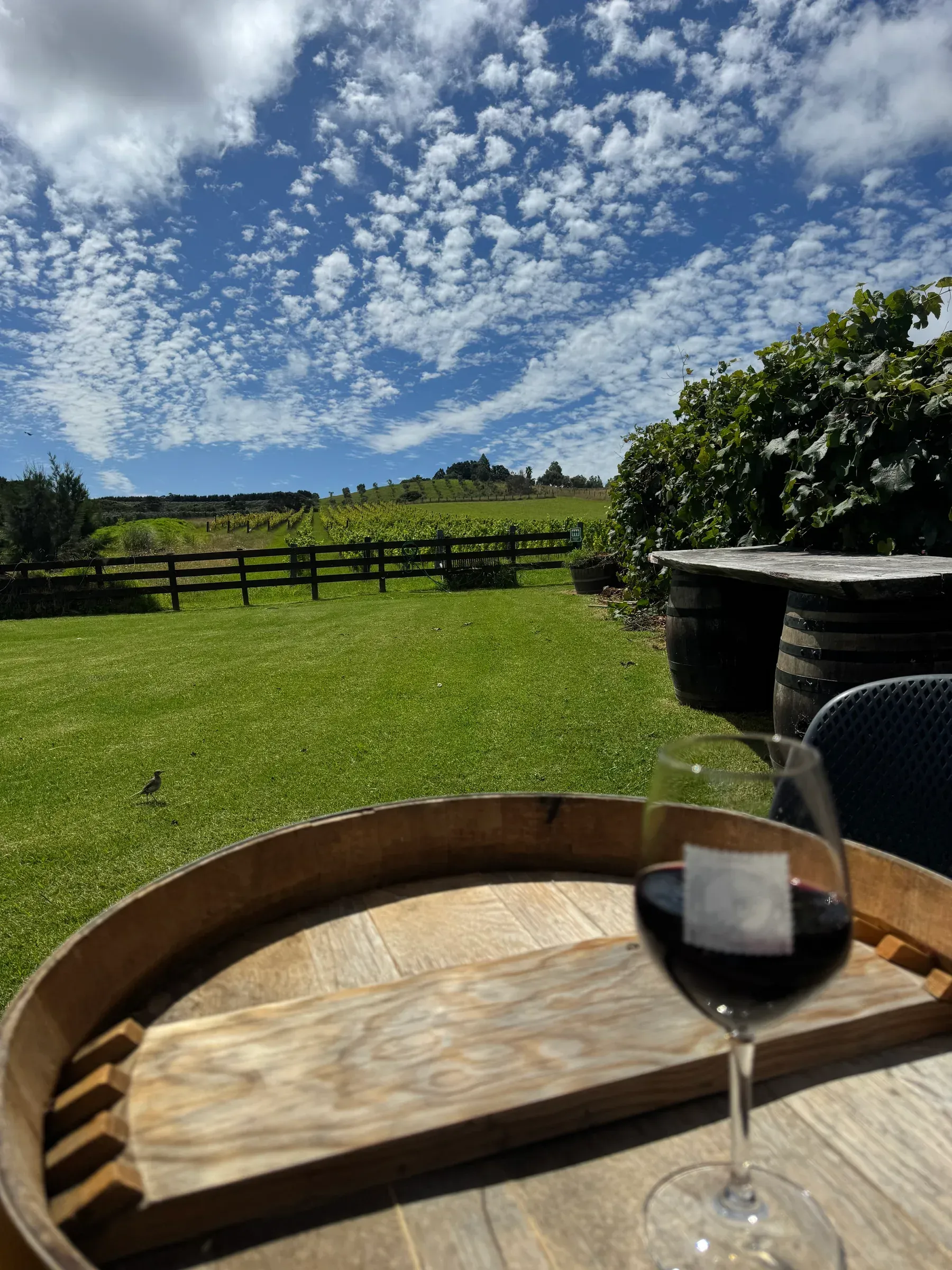
My favorite vineyards
Postage Stamp Wines
A small, family-run winery with a relaxed atmosphere and beautiful views over the surrounding vineyards. You taste handcrafted wines here while sitting quietly among the vines.
Stonyridge Vineyard
One of Waiheke's best-known vineyards, famous for its bold Bordeaux-style reds. The Mediterranean garden and restaurant make it a perfect spot for a long lunch with a view.
Te Motu Vineyard
A charming, slightly more out-of-the-way winery known for its elegant reds with real character. Good wine, an excellent restaurant and a relaxed setting make this one a must.
Mudbrick Vineyard
Maybe the most spectacular winery on the island, with panoramic views over the Hauraki Gulf and the Auckland skyline. At sunset especially, it's a magical place for a wine tasting or dinner.
Besides wine, Waiheke Island has beautiful beaches, fun boutiques and cozy bars. The island also grows a lot of olives. At Bistro Allpress you can taste different local olive oils and, of course, buy some to take home.
Along with the wineries there are also several breweries, so Waiheke really has something for everyone. Personally, I could live here. It feels a bit like a Western version of Bali: the atmosphere is relaxed, people are friendly and helpful, and even though it's popular, it never feels too crowded.
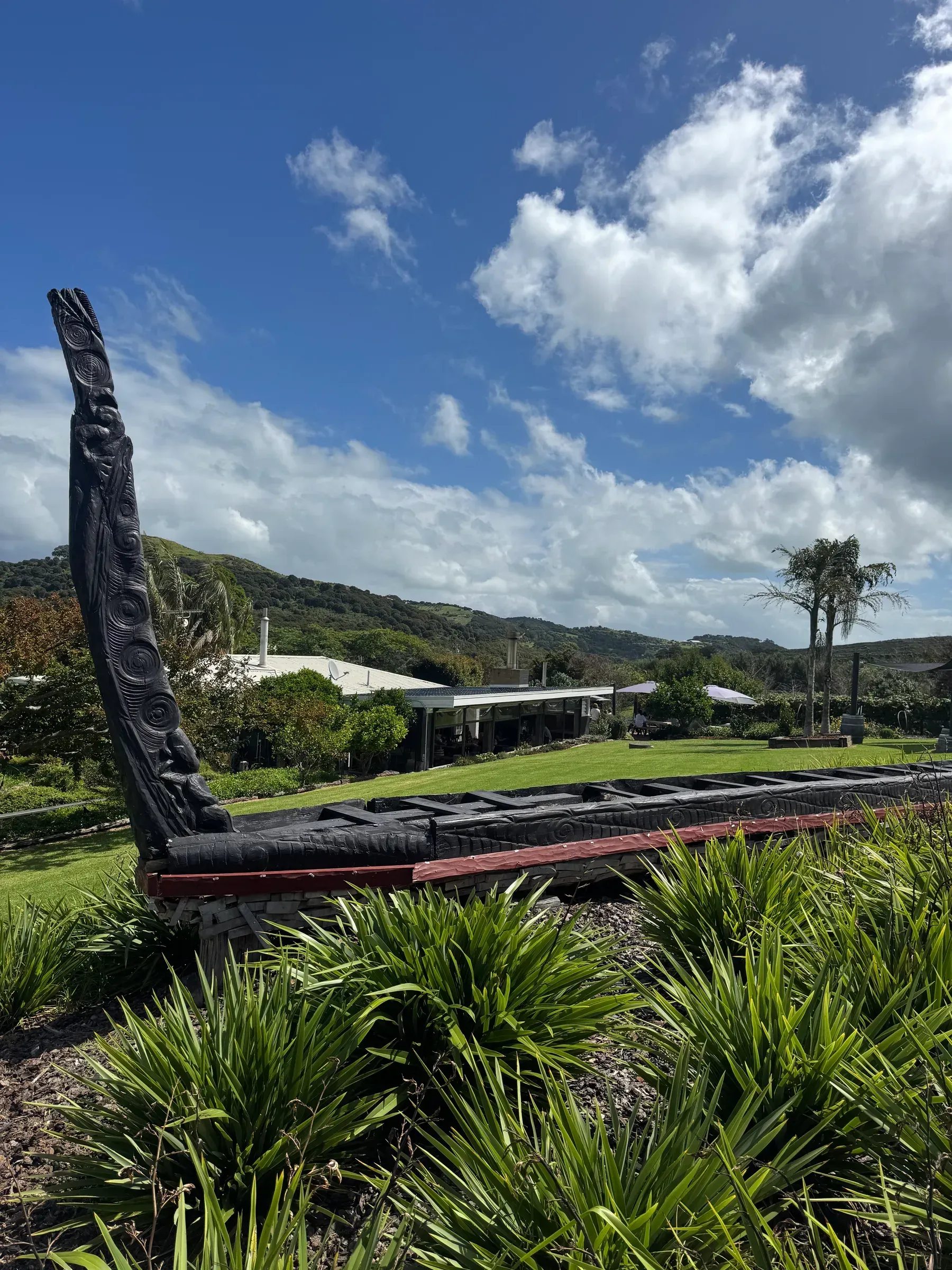
Waiheke Island was the last stop of my New Zealand road trip. After three days on the island I flew from Auckland back to Queenstown and went back to work as a tour guide.
At Good Day Travels you get travel advice tailored completely to your trip in Australia and New Zealand. I've spent a lot of time in every corner of both countries, and I'll help you plan your ideal trip Down Under.
End of route
Waiheke Island, day 27.